
AI: Weekly Summary
...week ending October 20, 2023


Welcome to the Saturday weekly AI summary here on ‘AI: Reset to Zero’. Here are this week’s AI highlights:
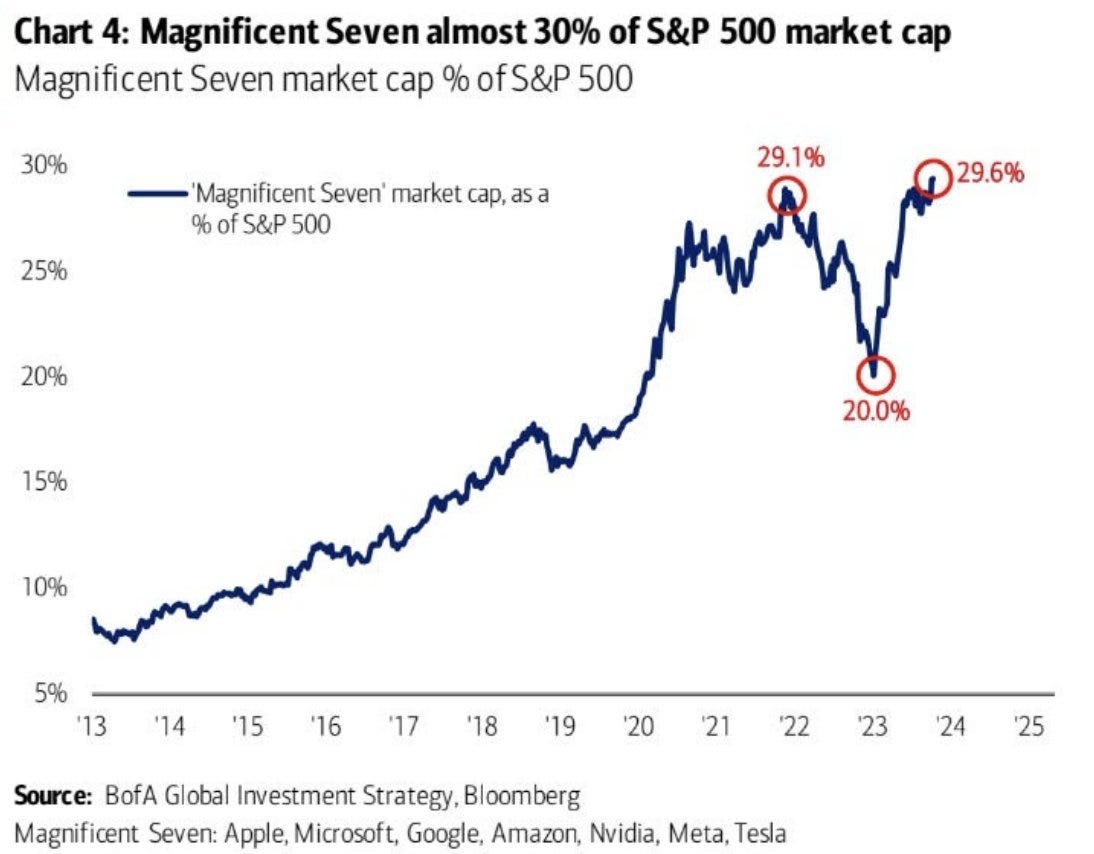
‘Magnificent Seven’ Big Tech upcoming quarterly Earnings reports: We’ll see continued discussion by the big tech companies on their AI ambitions, as the so-called ‘Magnificent 7’, Apple, Microsoft, Amazon, Google, Nvidia, Meta and Tesla, kick off their quarterly reports. Tesla went first this week with the rest to follow over the next few weeks. Expect a lot of focus on AI in the analyst Q&As for most of the companies. Note that these seven companies are a relatively historic near 30% of the S&P 500. My deeper dive here on this quarter expectations vs quarters past.
OpenAI had a busy week ahead of its upcoming November 6 Developer Day: Company had to take a step back on an LLM AI model named Arrakis,which used a technique called sparsity to deliver results similar to dense models. Dense models end up being more expensive and ‘brute force’ than the sparse approach, that emphasizes a ‘mixture of experts’ (MOE), to generate equivalent results. It’s not clear why Arrakis didn’t fare well here given that GPT-4 uses a sparse approach vs the dense approach of GPT-3.5 and earlier OpenAI LLM AI models. Separately, the company announced a secondary tender offer led by Thrive ventures at an $80 billion valuation.
Google ‘Bard Speed’ to Gemini: The linked piece highlights a faster pace culture at Google post OpenAI/Microsoft’s ChatGPT ‘moment’, as the company races towards releasing a multimodal Gemini LLM AI in the coming weeks. Stresses the intense focus on delivering safe and reliable AI driven services across Google’s products and services, despite multiple internal organizational islands. Separately, Google also announced some structural layoffs at ‘Google Bets’, and other properties.
Big Tech CEOs on AI: Two notable visible communications by Amazon CEO Jassy on their upcoming AI plans, and Microsoft CEO Satya Nadella’s letter to shareholders also stressing the same. It’s clear that with the exception of Apple, every big tech CEO deems it necessary to engage publicly and proactively on their AI plans and ambitions. One of the headwinds most of them have to execute against are the current tussles between US and China on AI and tech.
Stanford AI Transparency Index energizes ‘Explainability’ discussion: As highlighted earlier, Stanford CRFM, Princeton, and MIT published their ‘Foundation Model Transparency Index”, that is likely to get attention ahead of the regulatory discussions ramping up in the coming weeks. As expected, open source companies fared better, with the highest ranked company Meta coming in at no. 1 with Llama 2 with a 54% rating. Open GPT4 and Google came in nos. 3 and 5 with 48% and 40% rankings respectively. Lots of room for improvement for all. More detail here in this deeper dive.
Other AI Readings for weekend:
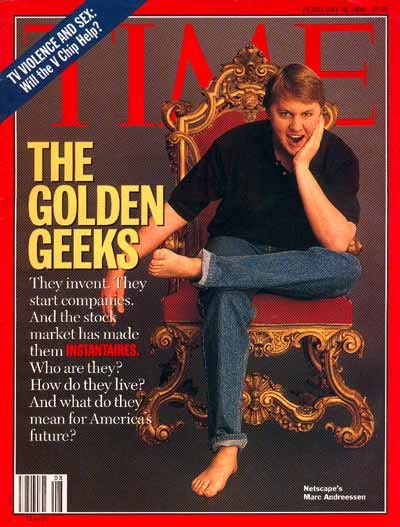
Marc Andreessen (a16z) published his pre-advertised ‘Techno-Optimist Manifesto’, leaning into an accelerated approach on tech and AI development and building. My deeper take here.
Useful summary of legal minefields ahead for LLM AI in the coming months. Lots to be either litigated or compromised against in settlements by the industry.
Thanks for joining this Saturday with your beverage of choice.
For your Sunday tomorrow, this week’s ‘The Bigger Picture’ is coming up. Stay tuned.
(NOTE: The discussions here are for information purposes only, and not meant as investment advice at any time. Thanks for joining us here)
Wasn’t there a report that MSFT was losing money with the integration of AI into Bing?