

Wall Street is starting to say the quiet part out loud about the AI data center build-out. Not that AI does not work. That the money to build it is getting harder and dearer to find, and that the revenue to pay it back will take longer to arrive than the borrowing assumed.
The Financial Times put it bluntly this weekend in ‘America’s $10tn AI infrastructure boom is starting to fray’: project delays, public backlash and shaky investor confidence are bringing a reckoning for the build-out underpinning the US economy. Axios landed in the same place in ‘The debt-fueled AI boom is cracking’, and the New York Times in ‘Weak Links Start to Show in A.I. Borrowing’. As one data center executive told the FT:
“It’s much harder today to finance a data centre.” (Data center executive, to the FT)

I have tracked this build-out here for over two years, as the biggest single driver of this AI Tech Wave. Two years ago, in ‘Multi-trillion $$ AI Data Center Compute Builds ahead’, the industry’s own estimates ran anywhere from $1 trillion to $9 trillion over a decade. As I put it then:
“The estimates of the AI Compute needed ahead, is directionally correct. The numbers required, be they hundreds of billions to trillions, are truly daunting… But we’ll get there even if a bit later than desired. The pace of the buildouts may not scale as fast as AI models themselves.” (RTZ #529, November 2024)
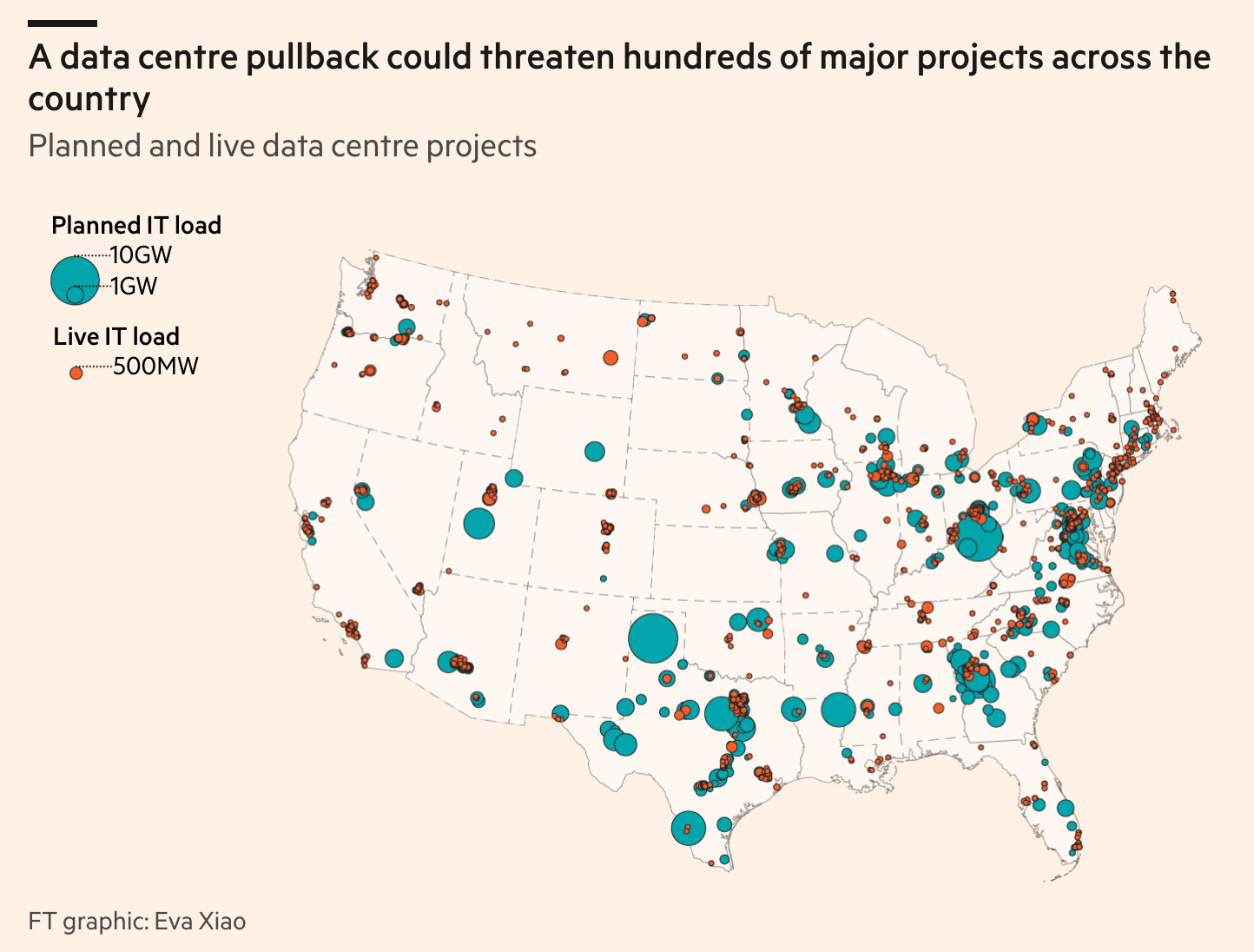
Today the US number alone is north of $10 trillion through 2032, and ‘a bit later than desired’ is starting to show up in the debt markets. So it is worth unpacking what is cracking, what is not, and what history says about how this plays out. First, a look at what is at stake across the country, as the FT lays out:
The cracks: delays, debt and doubts
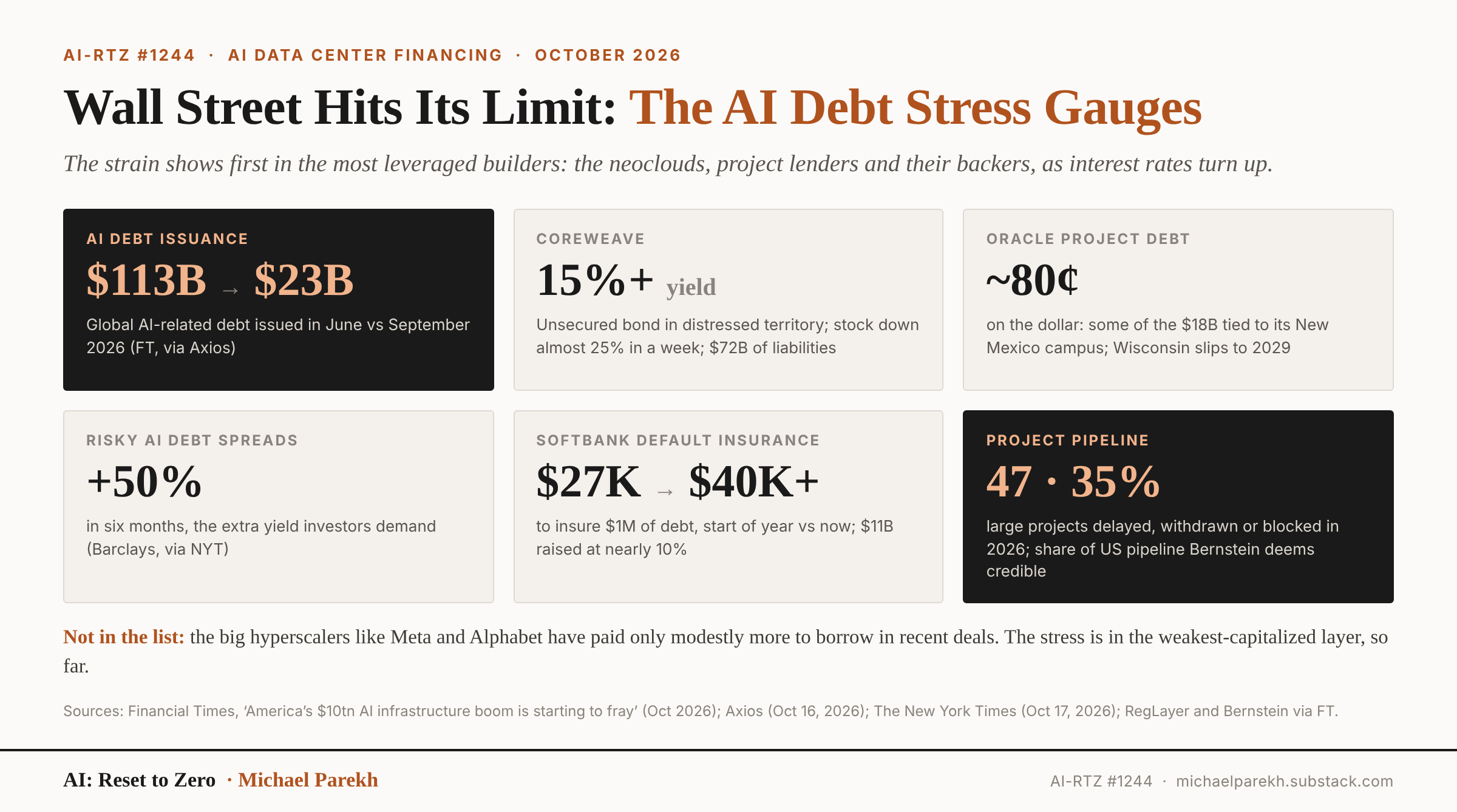
The FT lays out the physical side first. At least 47 large data center projects have been delayed, withdrawn or blocked in 2026, per regulatory data firm RegLayer, which calls that a conservative count. Bernstein estimated this month that only about 35% of the planned US data center pipeline is credible. And more than 1,000 communities across the US have tried to introduce moratoria or other restrictions on AI infrastructure this year, per FT research. Utility regulators are refusing grid connections unless projects bring their own power.
The politics have only intensified. As I wrote in August in ‘Data Centers become the Midterms’ Political Football’, more than 60% of Americans now oppose new data centers in their area, per a University of Pennsylvania poll, and governors from Texas’ Greg Abbott to New York’s Kathy Hochul have moved to make developers pay their own way, or pause them outright. The midterms are now just two weeks away, on November 3. My take then still holds:
“But moratoria do not repeal the supply and demand math; pausing the buildout while demand compounds just moves the crunch, and the price spikes, a few years down the road, or to the states and countries that kept building.” (AI-RTZ #1191, August 2026)
Then the financing side. The neoclouds, the newer AI data center providers I first wrote about in ‘Rise of the AI data center Neoclouds’ back in 2024, are where the strain shows first:
CoreWeave lost almost 25% of its stock value last week, and one of its unsecured bonds sank into distressed territory, with yields above 15%, per the FT and Axios. The NYT notes it has $72 billion in liabilities to operate 51 data centers, and that bond investors were pricing in a better than 60% chance it would miss its obligations. CoreWeave’s CEO called the moves irrational, and Nvidia’s Jensen Huang spoke up for it, which helped the stock rebound. The structural worry, per the NYT: CoreWeave signs data center leases of 15 years or more, but rents the capacity to customers like Meta, Microsoft and OpenAI for shorter terms, which is why some investors compare it to WeWork, a comparison CoreWeave rejects. I flagged the same mismatch in ARD #184.
SB Energy, majority owned by SoftBank and backed by OpenAI and Nvidia, has not completed a single data center, yet has $174 billion in capital needs to deliver on $430 billion in contracted future revenue, mostly from OpenAI, per the FT. Its IPO at a $50 billion valuation is on hold.
Nscale has a $45 billion Anthropic deal that Anthropic can walk away from if a major West Virginia project slips, with about 25,000 advanced chips online in August against nearly 500,000 planned. And on Sunday, the Telegraph reported that Microsoft has pulled out of anchoring Nscale’s first UK data center, in Loughton, Essex, where the grid is not expected to deliver power until the 2030s. That lands weeks before Nscale’s planned IPO of up to $3 billion, with Microsoft and Anthropic accounting for about 85% of its contracts, per its filing. Nscale says its relationship with Microsoft is unchanged, and it is weighing other power sources and sites. Nebius has raised maybe 20% of the roughly $250 billion its planned 5 gigawatts need, per its CEO.
Oracle, building for OpenAI’s Stargate, has seen some of the $18 billion of debt tied to its New Mexico project trade at around 80 cents on the dollar, per the NYT, and its Wisconsin campus now looks unlikely to run before 2029, just a year before related debt comes due.
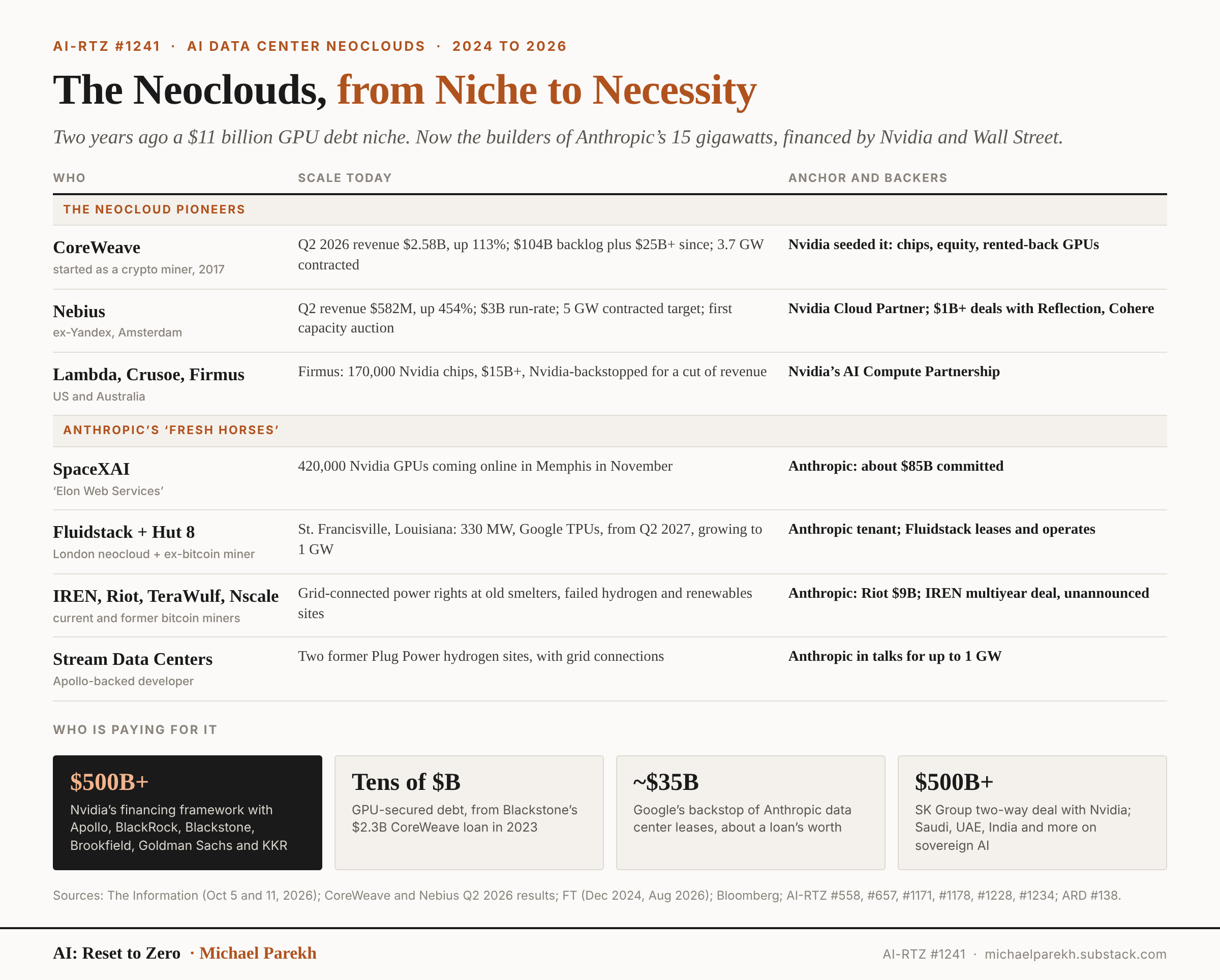
It is not just the young companies. OpenAI’s $500 billion Stargate effort has run into thwarted permits, delays and executive departures, including its computing lead Sachin Katti last week, as I noted in ARD #184. Former bitcoin miners building for Anthropic have renegotiated leases and stretched delivery dates. Cipher, for one, agreed to absorb the first $359 million of cost overruns on a Texas site for Fluidstack, Anthropic’s partner, per the FT. Anthropic’s own sprint to switch on capacity, which I laid out last week in AI-RTZ #1241, depends on many of these same partners.
Wall Street hits its limit
The bigger change is in the capital markets. Wall Street used to say there was nothing to worry about as long as the AI build-out was paid for in cash. Today about a third of AI capex is funded with debt, per Axios, and the markets are showing fatigue:
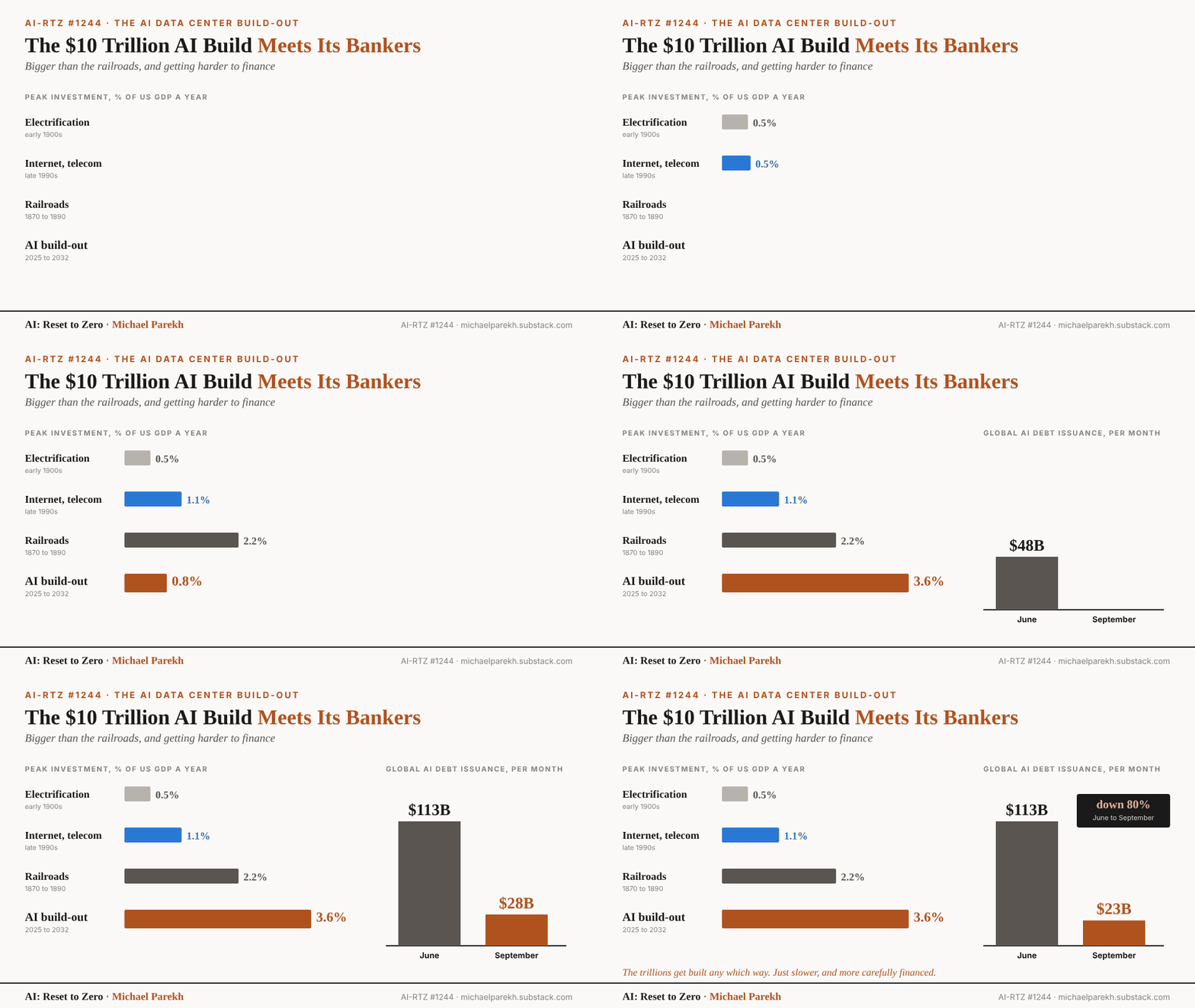
Global AI-related debt issuance fell to $23 billion in September, from $113 billion in June, per the FT.
JPMorgan’s Jamie Dimon has confirmed his bank is tightening credit to avoid concentration risk.
The extra yield investors demand on risky AI debt has jumped more than 50% in six months, per Barclays, cited by the NYT.
Insuring $1 million of SoftBank debt against default now costs more than $40,000, up from under $27,000 at the start of the year, after it borrowed a record $11 billion at nearly 10% ahead of its latest $30 billion OpenAI investment, per the NYT. And the IPO window is narrowing: Nvidia-backed Firmus shelved an IPO that sought more than $30 billion, and OpenAI has pushed its own into next year.
All this as the Federal Reserve has begun raising interest rates to fight inflation, which the data center boom itself is helping to drive, per the NYT. I flagged that macro headwind in ARD #180, as the blockbuster debt deals for Oracle, Broadcom and SpaceX lined up.
Note who is not in the list. The big hyperscalers like Meta and Alphabet, which still borrow heavily, have had to pay only modestly more in their recent deals, per the NYT. The stress is concentrated in the most leveraged, least seasoned layer of the stack.
The math: $7 trillion of spending, $3.6 trillion of revenue
Behind the market moves is a simple mismatch. Gartner put numbers on it last week in ‘Over $3.5 Trillion of AI Infrastructure Spending Could Be Exposed to Impairment by the End of 2030’. AI infrastructure spending runs nearly $1 trillion this year and about $6 trillion more from 2027 to 2030, roughly $7 trillion in all. To earn back that capital, financing costs and a 12% return, the industry would need about $8.5 trillion in cumulative revenue. Gartner forecasts no more than $3.6 trillion of revenue attributable to AI data centers over that period.
The result, per Gartner: more than $3.5 trillion of AI infrastructure exposed to impairment by the end of 2030, more than $4 trillion by 2032, and more than 80% of neocloud providers ceasing to operate independently by 2030.
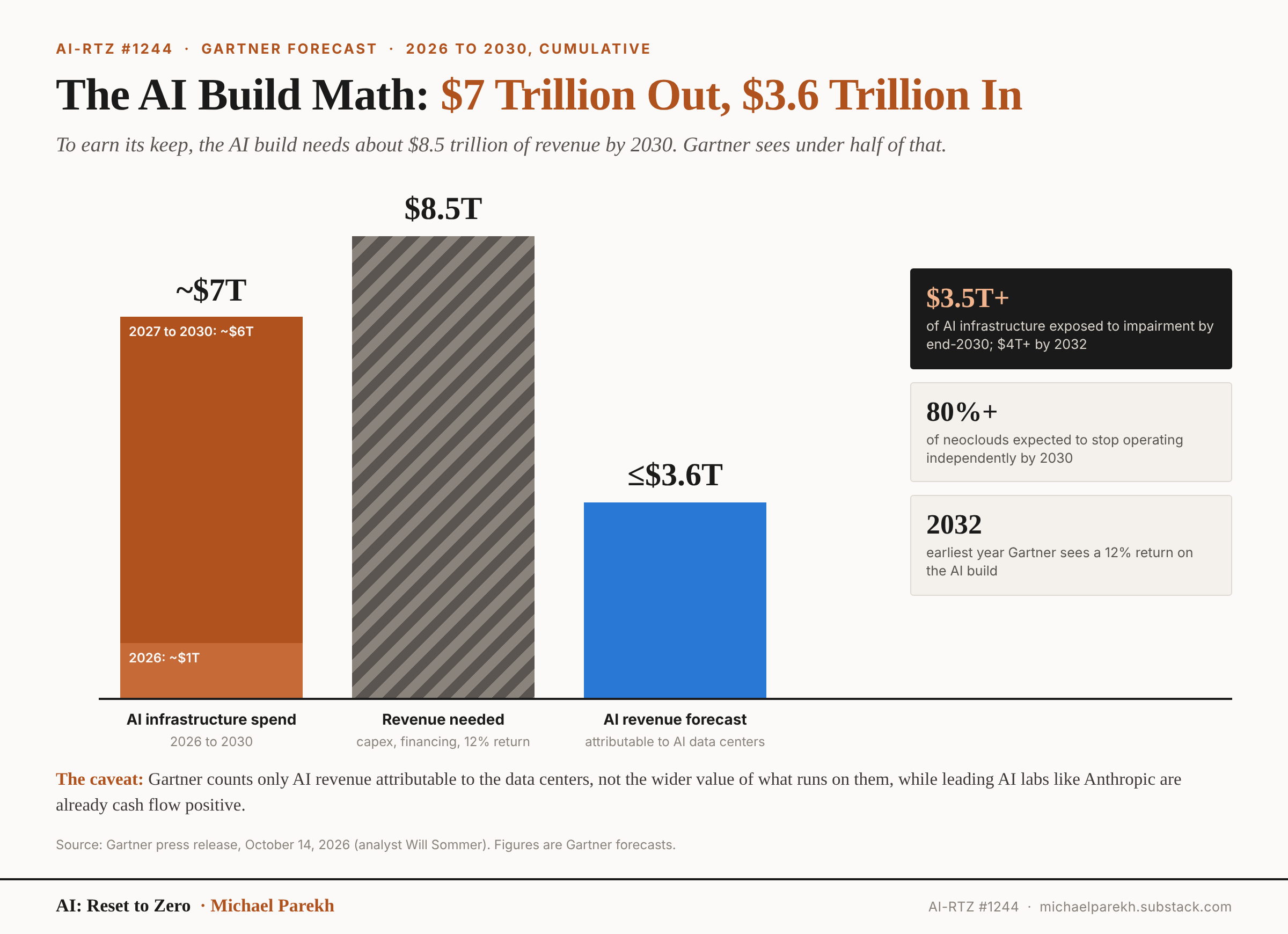
Two caveats, in fairness to the bulls. First, Gartner’s revenue line counts only AI revenue attributable to the data centers, not the full economic value of what runs on them. Second, the demand signals are still strong where it counts. Anthropic turned free cash flow positive in the third quarter and grew revenue nearly 50% from the prior quarter, as Axios notes and I discussed in AI-RTZ #1242. Rental prices for even four-year-old Nvidia chips were rising this summer, as I laid out in AI-RTZ #1178, and CoreWeave says it has sold nearly all of its 2027 capacity.
The real gap is one of timing. As Reflection AI co-founder Ioannis Antonoglou told Semafor, per Axios, businesses may need a decade or two to redesign their operations around AI. The data centers have to be paid for now.
Bigger than the railroads
To appreciate the scale, Columbia economist Stijn Van Nieuwerburgh estimates in a Brookings paper, ‘The $10 trillion question: Financing the AI buildout’, that US spending on AI data centers, power and chips will reach about $10.3 trillion from 2025 to 2032. That is about 3.6% of US GDP a year, roughly 50% above the peak of the railroad boom, and more than three times the internet and telecom build-out of the late nineties.
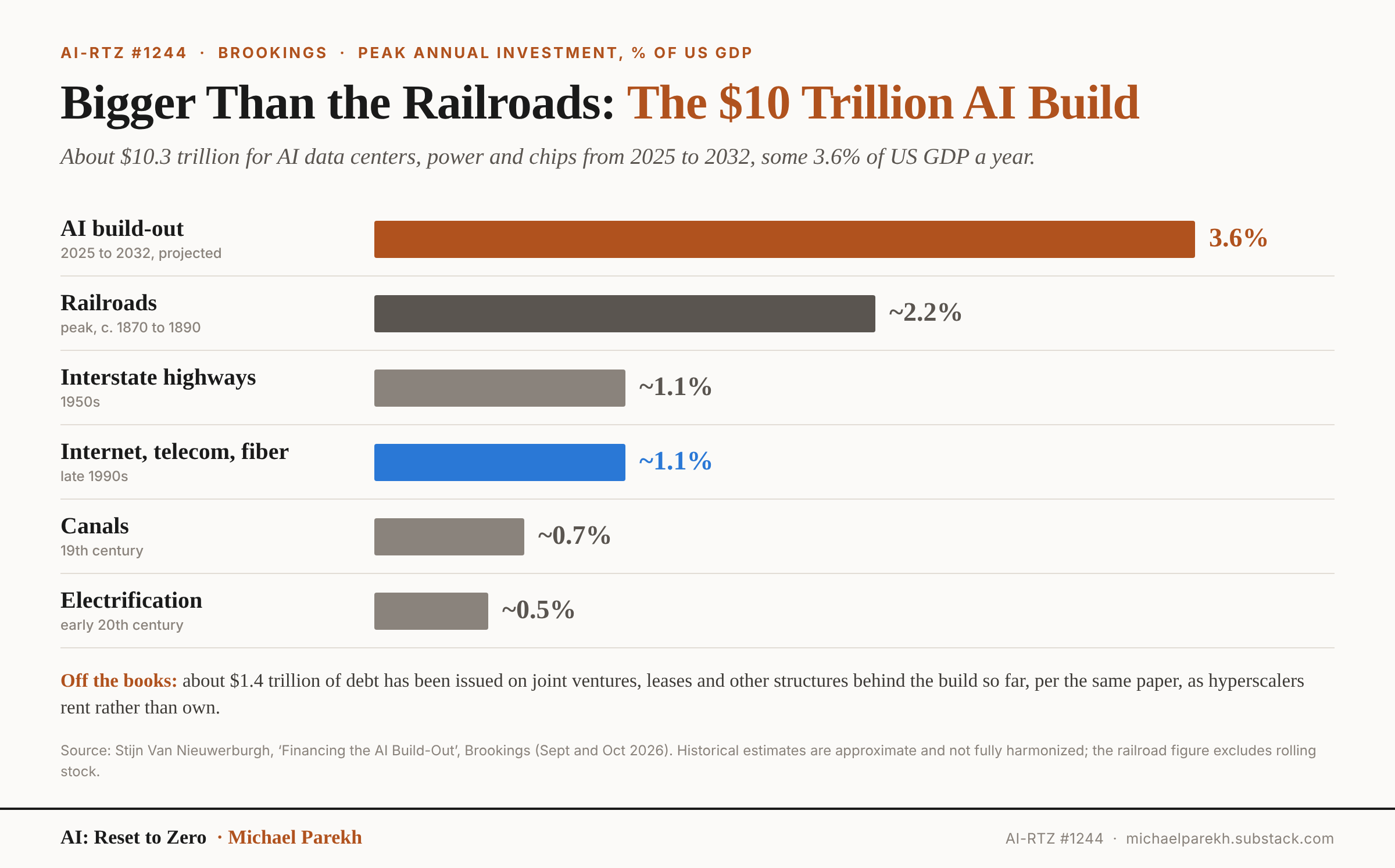
And more of it is moving off the balance sheets of the companies that will use it. Instead of owning their data centers, the hyperscalers increasingly rent them through joint ventures, special purpose vehicles, leases, private credit and securitizations, with about $1.4 trillion of debt issued on these structures so far, per Van Nieuwerburgh. Meta’s Hyperion campus in Louisiana is the template: a joint venture with Blue Owl that borrowed $27 billion against an asset valued near $30 billion. Nvidia, meanwhile, has become what I called the ‘Uber AI Investor & Banker’ for its customers, backstopping loans and financing frameworks, as I laid out in AI-RTZ #1234.
That structure spreads the risk, but it also spreads it into places investors are only now examining closely, from the depreciation assumptions on the chips, which I discussed in RTZ #904, to the wider financial system, which the Bank for International Settlements warned about in its annual report this summer, as I noted in AI-RTZ #1134.
And Nvidia has the most riding on how this shakes out. Its customers outside the big hyperscalers, mostly neoclouds plus enterprises and industrial buyers, were $40 billion, or 45% of its data center revenue, in the July quarter, more than double a year earlier, per The Information. Nvidia is already adjusting, offering neoclouds shorter-term credit support for a smaller cut of their future revenues, and it has signed $20 billion of its own data center leases to pass on to them. The distinction that matters: a neocloud that mainly leases its sites, like CoreWeave, could fail without stranding the buildings, which would find new tenants. One that builds its own, like Nebius, IREN or Nscale, could stall the build-out itself, and with it Nvidia’s sales.
Booms that rhyme
None of this is new in the history of big infrastructure waves. I wrote about it three years ago in ‘Booms that Rhyme’, looking back at the telecom and fiber boom that accompanied the Internet wave:
“The telecom infrastructure SUPPLY that got built in the 1990s into the early 2000s was built so far ahead of the eventual DEMAND, that the networks were less than 5% used at the end of that time frame.” (‘Booms that Rhyme’, October 2023)
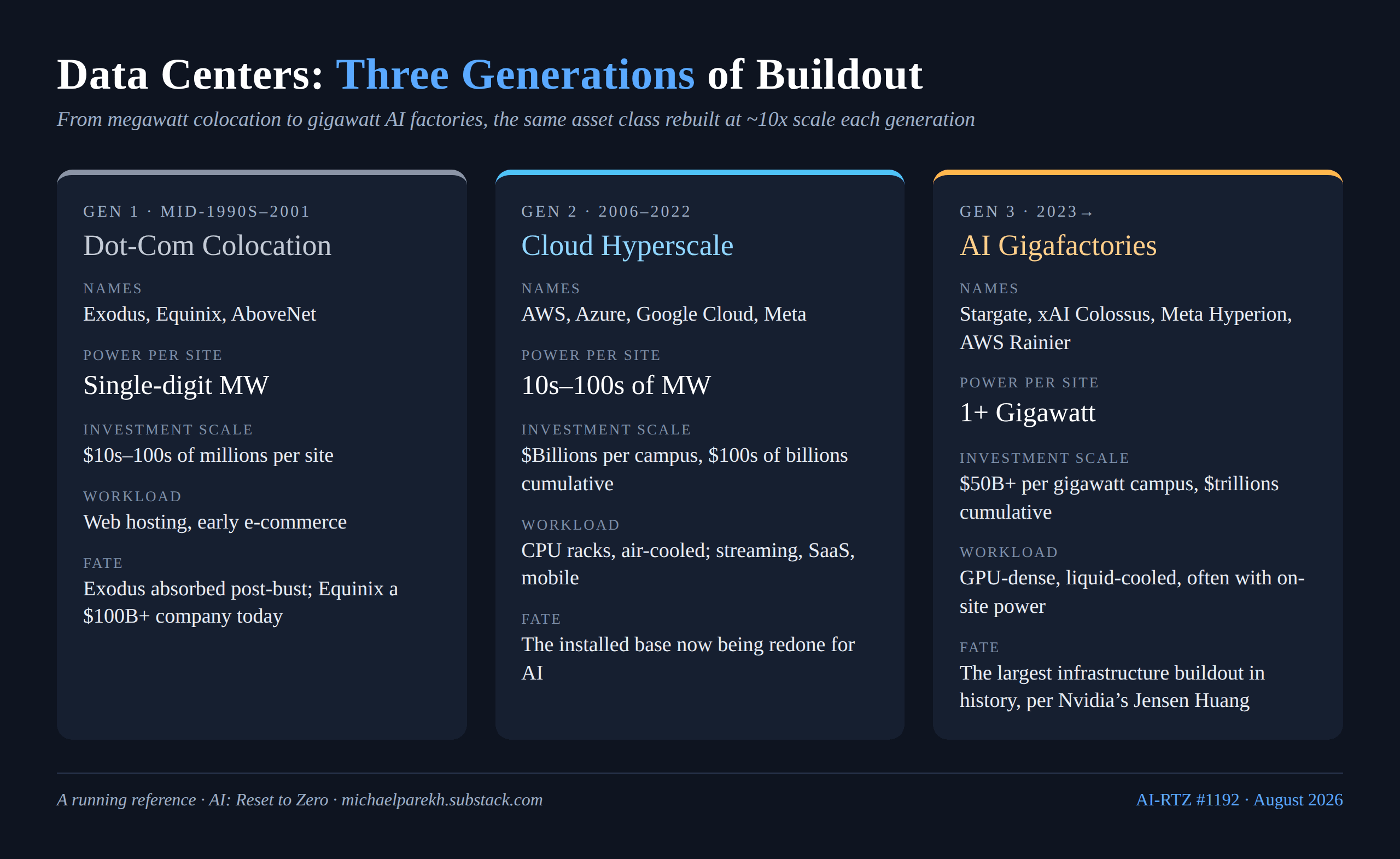
And then demand caught up, and ate all of it. The railroads were catastrophically overbuilt too, and their crash handed the economy cheap freight that built everything from Sears catalogs to steel towns, as I laid out in AI-RTZ #1180. Having helped take the first internet data center companies public at Goldman Sachs in the late nineties, I wrote in Data Centers 101 this August:
“Exodus did not survive the dot-com bust, its assets absorbed into other entities over the years. Equinix is still very much with us, a hundred-plus billion dollar company built on those same foundations. Same buildout, opposite corporate fates, and the infrastructure itself kept compounding value through both.” (AI-RTZ #1192, August 2026)
Gartner’s forecast that 80% of neoclouds will not stay independent reads a lot like that story, with the bigger, better capitalized players absorbing the capacity the weaker ones built. The neocloud executives themselves now say as much. Two told The Information that only seven to 10 neoclouds will remain in a few years, out of the hundreds trying to get going today, with deeper-pocketed asset managers, telecom and fiber companies, and the bigger neoclouds as the likely buyers.
My take
Three things to keep in mind.
First, this is a financing cycle more than a demand cycle. Demand for AI Compute is still running ahead of supply at the frontier, with chip rental prices up and the leading AI labs sold out of capacity. What is cracking is the cost and availability of money for the most leveraged builders, just as interest rates turn up. Those are the weak links, not yet a broken chain.
Second, expect consolidation and stretched timelines rather than a collapse. Some of today’s builders will not survive their own capital cycle, as I said in Data Centers 101. Their capacity will be bought, often at a discount, by the hyperscalers, the AI labs, Nvidia’s financing partners and private equity. As one asset manager told the NYT, slower financing makes existing AI infrastructure even more valuable. The 2030 build-out targets may become 2032 or 2033 targets, and the AI labs’ walk-away clauses will get tested.
Third, watch the timing gap. The chips and data centers are paid for upfront, while the revenue arrives over a decade or more of businesses slowly redesigning around AI. That is where the real risk sits, for investors in the neoclouds and their debt, and for the mega-AI IPOs of Anthropic this fall and OpenAI next year, which will be priced in this tougher market. The markers to track: credit spreads on AI debt, the IPO window, the Fed, the data center votes in the November 3 midterms, and whether the AI labs keep growing revenue fast enough to grow into the build.
As I said in Data Centers 101, the facilities, the fiber and the power will compound value for decades, whoever’s logo ends up on the door.
The trillions in AI infrastructure get built any which way in this AI Tech Wave. Just a little slower, and a lot more carefully financed, than the plans of the last two years assumed. Stay tuned.
Sources and further reading
Financial Times, ‘America’s $10tn AI infrastructure boom is starting to fray’, October 2026
Axios, ‘The debt-fueled AI boom is cracking’, October 16, 2026
The New York Times, ‘Weak Links Start to Show in A.I. Borrowing’, October 17, 2026
Brookings, ‘The $10 trillion question: Financing the AI buildout’, Stijn Van Nieuwerburgh
The Information, ‘Neocloud Shakeout Looms, and Nvidia Has a Lot to Lose’, October 18, 2026
The Telegraph, ‘Microsoft axes AI deal in setback for UK data centre pioneer’, October 18, 2026
Reuters, ‘Microsoft pulls out of UK data center deal with Nscale, Telegraph reports’, October 18, 2026
For longtime readers
RTZ #529: Multi-trillion $$ AI Data Center ‘Compute’ Builds ahead
RTZ #904: Appreciating AI Infrastructure Depreciation Curves
AI-RTZ #1134: Latest report on an AI Bust & the Global Economy
AI-RTZ #1191: Data Centers become the Midterms’ Political Football
AI-RTZ #1241: Anthropic’s Mega Data Center Sprint ahead of its Mega-AI IPO
ARD #180: ‘More of the Same’ in AI. OpenAI vs Anthropic, AI Debt & Rates
(NOTE: The discussions here are for information purposes only, and not meant as investment advice at any time. Thanks for joining us here.)
Consolidation and delayed timelines rather than collapse is the outcome I would expect too, and I think the history supports it more than the bubble framing does. Every technological revolution Perez traces left its infrastructure standing while its financiers changed hands. The railways ran after 1847 and the fiber carried traffic after 2001, under new owners and at prices written down to what the assets could earn. The Gartner gap between what the build costs to finance and what it can bill by 2030 reads to me as the size of that ownership transfer rather than the size of the loss to the economy. Here is what I am watching. Who holds the title to the data centers after the write-downs, and does that owner's cost of capital look more like a utility's than a startup's?