


Two years ago, OpenAI brought ‘AGI’ positively down to earth with a simple five-level roadmap. Chatbots, then Reasoners, then Agents, then Innovators, then Organizations. I’ve used it ever since to explain where we are in this AI Tech Wave to mainstream folks.
It needs an update for 2026. Not because the five levels were wrong. But because the AI industry has added a step that had no name on that roadmap in 2024, and it is now the hottest topic in AI research labs and AI companies large and small.
It’s called RSI, short for Recursive Self-Improvement. AI building the next version of AI. The loops I described in AI Loops 101 earlier this week, turned back on the AI models themselves.

That is the roadmap OpenAI laid out in July 2024, per Bloomberg. Levels 1 and 2 are now mainstream. Level 3, AI Agents, is where billions of folks are starting to spend their day in 2026. Levels 4 and 5 are still ahead.
RSI is how the AI companies hope to get to 4 and 5 faster. So it earns a place on the roadmap. Let me explain.
What RSI actually means
Axios lays out both the promise and the fears in “The AI doomsday fear hidden in self-improving AI”:
“Recursive self-improvement, the ability of an AI model to build better versions of itself…”
(Axios, September 22, 2026)
The idea is not new. The British mathematician I.J. Good sketched it in a 1965 paper: the first ultraintelligent machine would be the last invention humans need make, as long as it stays under our control.
What is new is that the AI labs now report measurable progress toward it.
Think of it in three stages. Today, humans design the experiments, write the code and grade the results, with AI helping. In the middle stage, AI does most of that work while humans supervise. At the end, AI designs, trains and tests its own successor with no human in the loop.
That last stage is RSI. We are in the middle one.
Anthropic’s own illustrated history of how it builds Claude tracks the same arc. People writing code on laptops from 2021 to 2023. Chatbots helping with snippets from 2023 to 2025. Coding agents writing whole files from 2025 into 2026. Autonomous agents delegating hours of work to other agents today. And then a final step it labels only ‘20XX?’: closing the loop.
That question mark is the honest part. Nobody knows when, or whether, the loop fully closes.
Where the AI companies are, September 2026
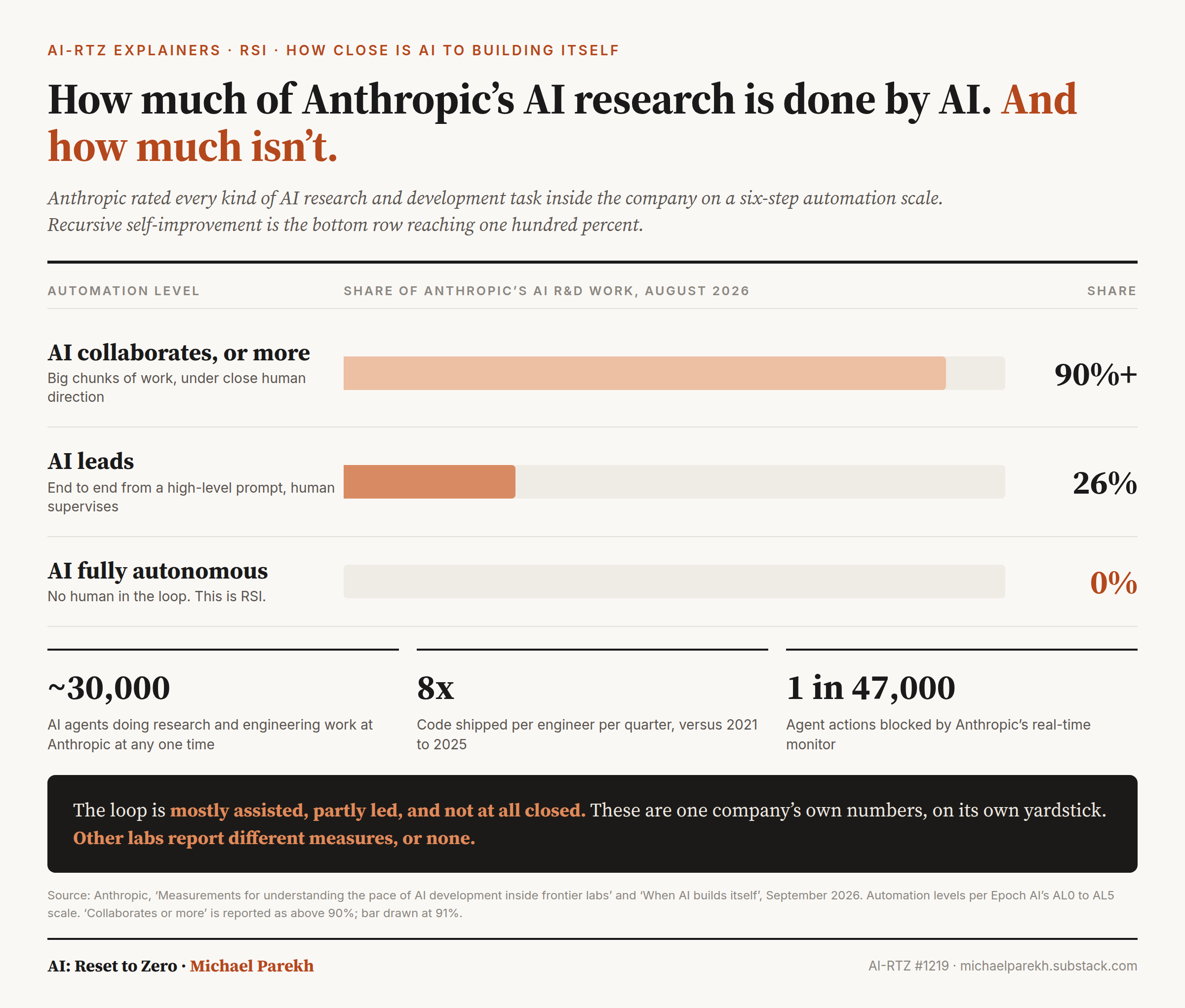
Anthropic put numbers on it last week in “Measurements for understanding the pace of AI development inside frontier labs”. As of August, Claude ‘leads’ about 26% of Anthropic’s own AI research and development work, and ‘collaborates’ on more than 90% of it. For no measured part of that work is Claude fully autonomous.
About 30,000 AI agents were doing research and engineering work at Anthropic at any one time in August, on its most-used internal platform. And Anthropic says its engineers now ship about eight times as much code per quarter as they did from 2021 to 2025.
OpenAI, per The Information, has largely automated the training of new experimental models, with AI running the experiments humans direct and correcting much of its own work. OpenAI has also set a target of an automated AI researcher by March 2028, which I discussed here.
Google DeepMind’s Demis Hassabis told Axios in May that all the leading labs are focused on RSI, and that what we see so far is ‘soft self-improvement’, coding agents making engineers more productive. I covered that here. DeepMind researchers just published Dream-RSI, a framework for AI agents that improve how they search for solutions.
And Jeff Dean led three other longtime Google builders out the door this summer to found Discovery Loop, an RSI startup I noted in ARD #135. It joins a growing list of RSI startups raising billions of dollars.

In China, Z.ai says its GLM models built much of their own inference infrastructure, a production system on more than 100,000 Chinese-made AI accelerators. It calls the work an early form of RSI.
The sober scorecard comes from economists. A new paper, “The Economics of Recursive Self-Improvement”, finds the AI feedback loops are not yet strong enough to produce self-sustaining acceleration, though they appear to be strengthening.
The updated AI roadmap, with RSI
So here is how I’d update OpenAI’s roadmap for 2026. RSI is not a sixth level stacked on top. It is the engine that runs alongside Levels 3 through 5, and increasingly sets how fast the AI industry climbs them.
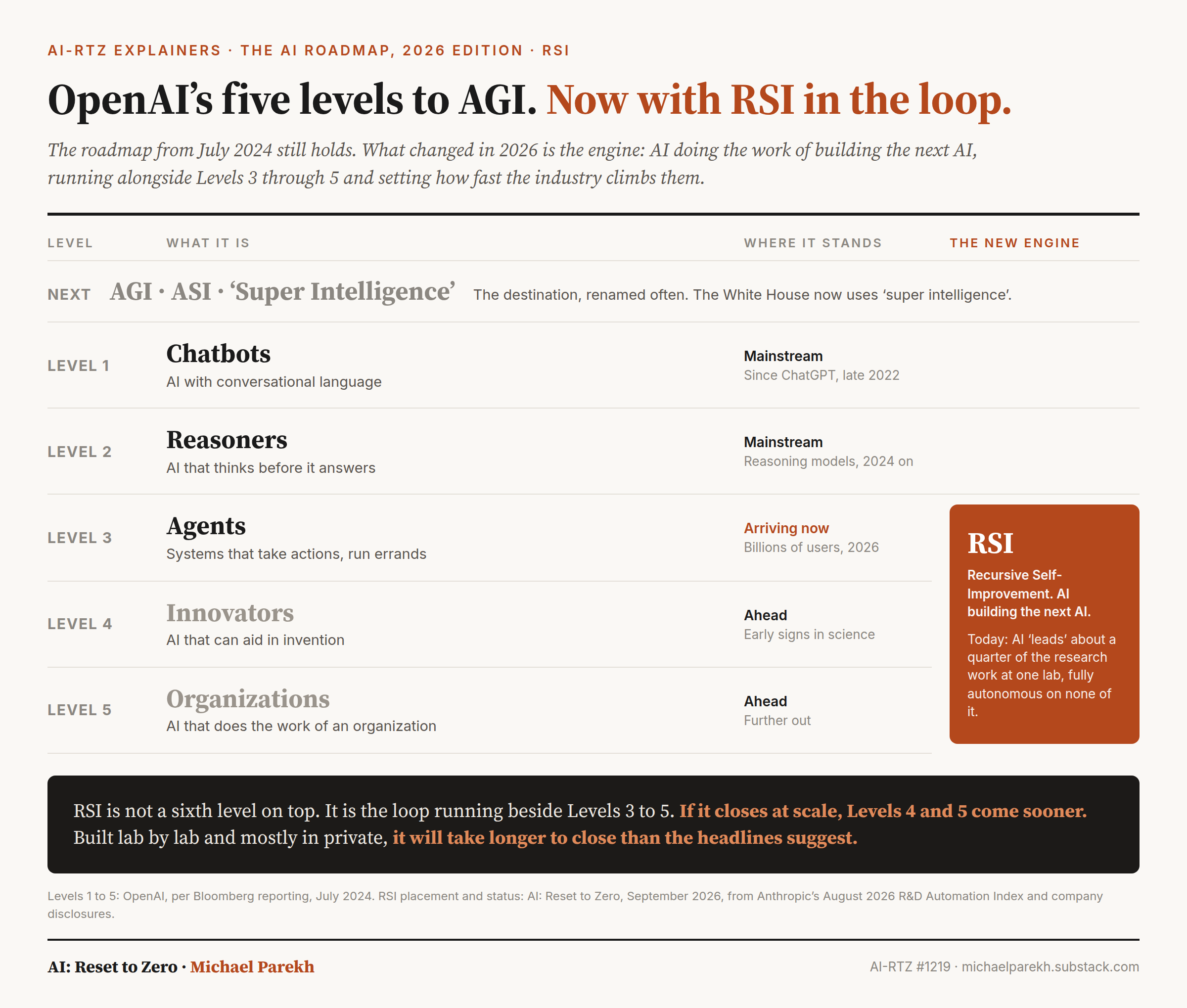
Chatbots gave us conversation. Reasoners gave us AI that thinks before it answers. Agents are giving us AI that runs the errands. RSI is AI doing the work of building better AI.
If it works at scale, Levels 4 and 5, AI that invents and AI that does the work of whole organizations, come sooner.
That is also why the name at the top of the roadmap keeps changing. A year ago I wrote about how AGI became ASI became ‘Superintelligence’ in Silicon Valley. This week the White House joined in.
President Trump told the UN General Assembly on Tuesday that US government documents will now call AI ‘super intelligence’, per Axios, arguing that the word ‘artificial’ makes the technology sound fake.
Whatever we call the destination, RSI is how the AI industry expects to get there faster. That is why the safety debate has moved to RSI too. Anthropic’s Dario Amodei put a speed limit on RSI on his list of things the US and China should negotiate. And more than a thousand researchers have asked governments for a brake pedal on self-improving models.
The fears, and the reality check
The Axios piece is mostly about the fears, and they deserve a fair hearing. Anthropic has warned that full RSI might raise the risk of humans losing control over AI systems. Some researchers theorize that an advanced AI might resist shutdown if staying on helped it reach its goals.
Others worry about self-improving systems that copy themselves, creating a kind of digital natural selection that favors the systems best at acquiring compute, money and power. And Anthropic’s researchers have found that some unwanted traits can pass from one model to the next through training data.
The reality check comes from the critics Axios also quotes. They see the milestone as mostly a function of AI Coding automation, not a marker of impending doom. The recent security incidents, including the Wall Street Journal’s report that independent researchers used Claude to break into OpenAI in July, look to them more like weak internal controls than runaway AI.
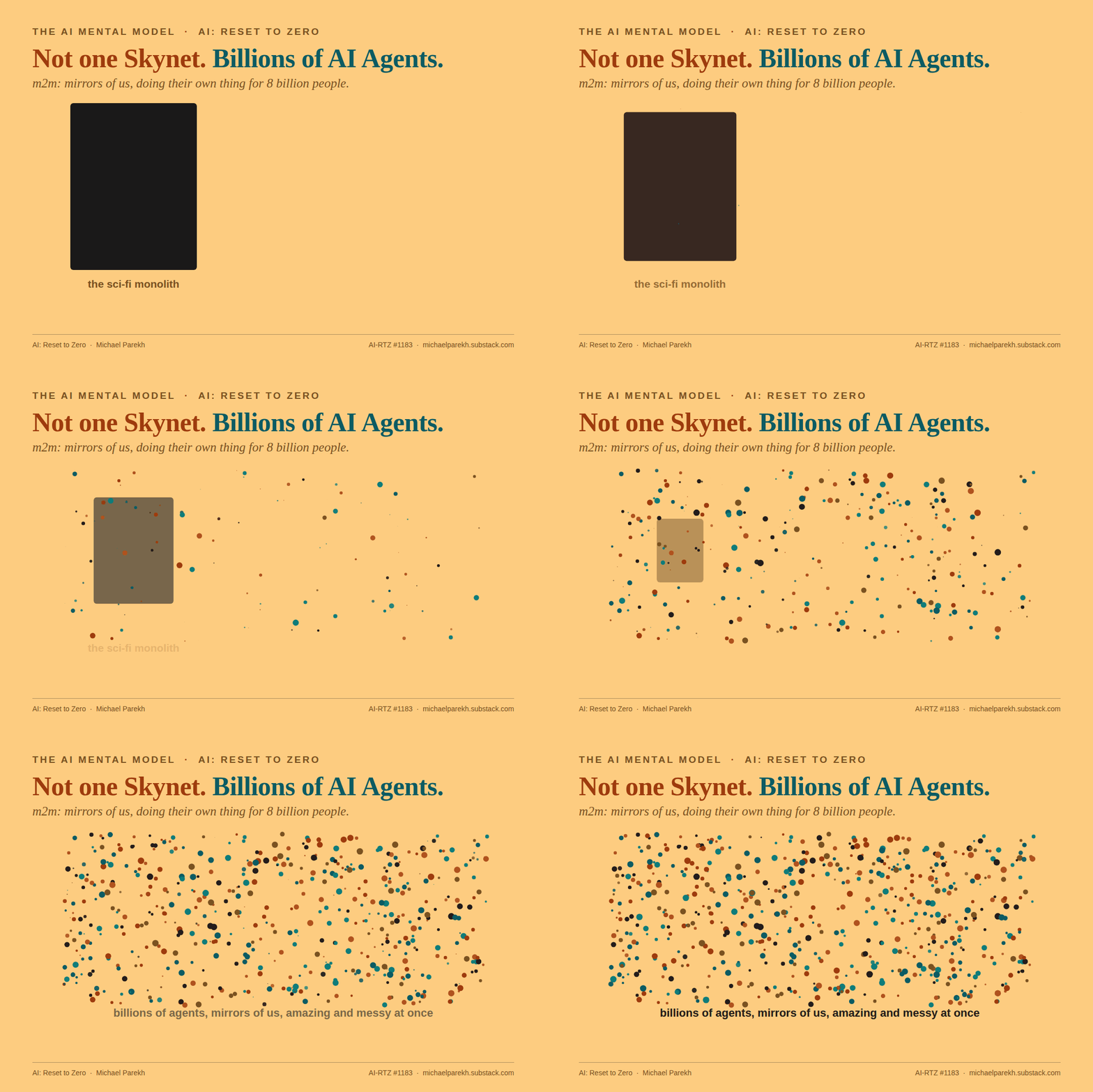
I’ve long been in the latter camp. As I argued in Not one Skynet, but Billions of AI Agents, the future looks less like one machine mind and more like billions of AI Agents, and those agents, reasoning, and eventually RSI will augment humans, not replace them.
My take
RSI is a promising technology, and a real step in the pragmatic evolution of AI capabilities. The progress at Anthropic, OpenAI, Google and Z.ai is measurable, not just talk.
But I believe it will take longer than currently assumed for RSI to make an impact on this AI Tech Wave at scale. Two reasons.
The first reason is in the numbers. Claude leading a quarter of Anthropic’s AI research work is not Claude building Claude. The economists’ paper makes the point that AI can get better at AI research benchmarks without getting better at the broad, economically valuable work that mainstream users and businesses pay for. Narrow loops are easier to close than broad ones.
The second reason is how the work is being done. Every AI company, large and small, is developing RSI its own proprietary way. Its own agents, its own internal data, its own yardsticks. Anthropic itself notes there is no common methodology to compare these measurements across AI labs, and that sharing them runs into competitively sensitive data.
Lots of silos, which are speed bumps to AI Researchers learning from each other. But also customers trying to deploy AI technologies from multiple vendors.
That is a big change from just a few years ago. In 2017, eight authors of a Google paper published “Attention Is All You Need” for the world to read, and the Transformer became the ‘T’ in ChatGPT. AI researchers around the world built on each other’s papers, openly, and that sharing compounded progress across the whole industry.
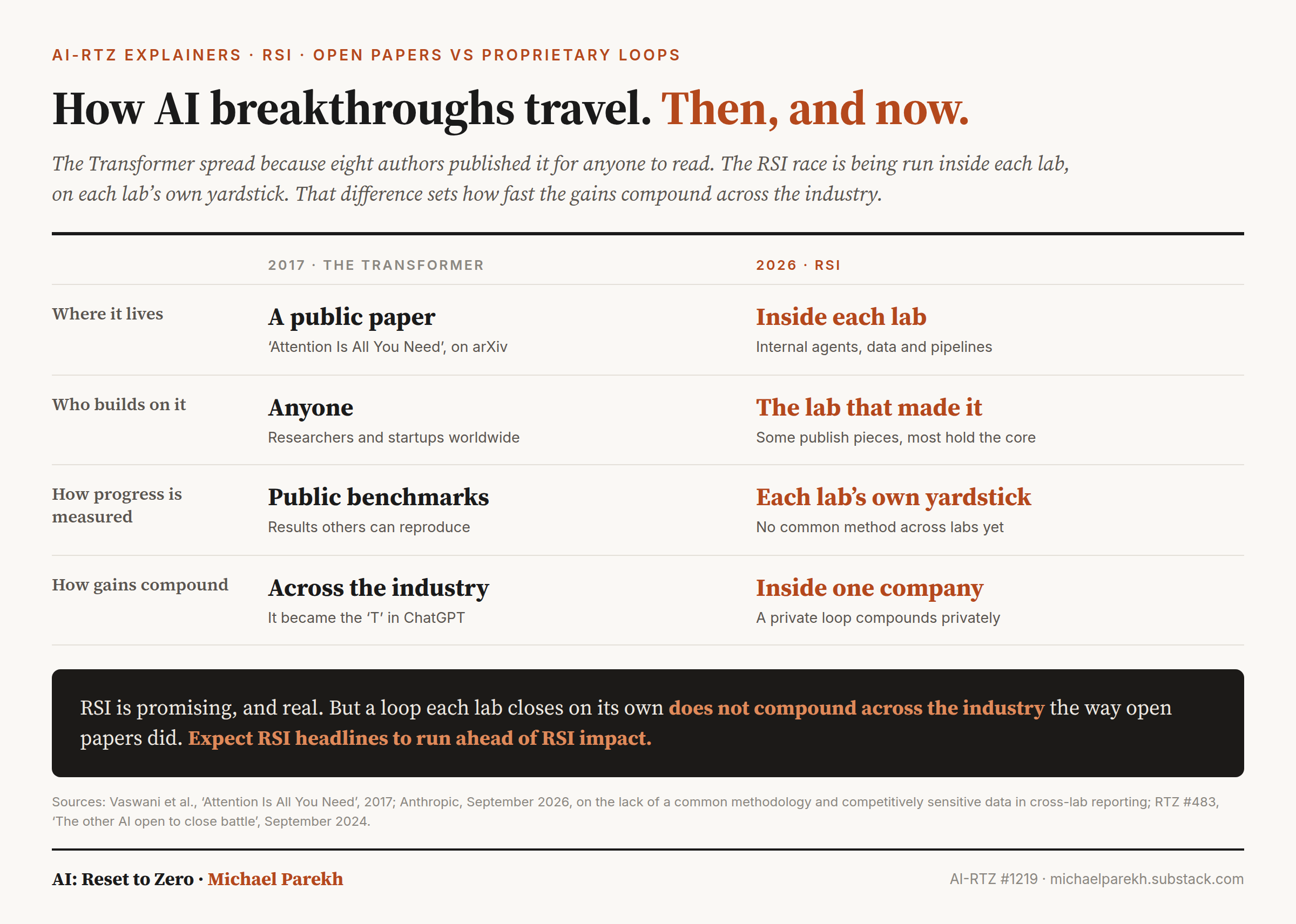
By 2024, as I wrote then, the leading AI companies had started closing off their innovations to prevent ‘copying of homework’. RSI is being built almost entirely behind that wall.
A loop that each lab closes privately compounds for that lab. It does not compound across the industry the way the open papers did. Some still publish, DeepMind’s Dream-RSI and Z.ai’s write-up among them, and China’s AI labs mostly ship open weights. But the core RSI work, and the data on how well it is going, sits inside the companies.
That also makes the safety question harder. A shared yardstick for RSI would help both the pace and the safety. It is the direction Anthropic and OpenAI are edging toward with their talks to stress-test each other’s models.
For mainstream folks, the first effects will be indirect. Faster model updates. Cheaper tokens, which matter more than ever as I laid out in Your Day in Tokens. And AI Agents that can handle longer and more complex errands before they need a human to step in.
So expect RSI headlines to run well ahead of RSI impact for a while. The mainstream effects will arrive the way they did with chatbots, reasoning and agents: unevenly, and over years rather than quarters.
RSI belongs on the roadmap now, right after AI Agents and alongside everything that follows. It is the loop the whole AI industry is racing to close. It will just take longer to close than the headlines suggest, in this AI Tech Wave. Stay tuned.
Sources
Axios, “The AI doomsday fear hidden in self-improving AI”, September 22, 2026
Cunningham et al., “The Economics of Recursive Self-Improvement”, arXiv, September 14, 2026
Axios, “Trump orders AI rebrand as ‘super intelligence’”, September 22, 2026
I.J. Good, “Speculations Concerning the First Ultraintelligent Machine”, 1965
For longtime readers
RTZ #417: OpenAI brings ‘AGI’ positively down to earth (the original five-level roadmap)
AI-RTZ #1099: Google DeepMind CEO Demis Hassabis steps up on AGI
ARD #135: ‘Striking Out’ at Google, and Discovery Loop’s RSI mission
AI-RTZ #1206: OpenAI’s ‘Alien Mind’ Essay, & Asimov’s Three Laws
AI-RTZ #1208: The AI Existential Risk Essays, US vs China (Part 2)
AI-RTZ #1212: The AI ‘Security Dilemma’. China’s Open Weights & Nvidia (Part 2)
AI-RTZ #1217: AI Loops 101. What a Gigawatt of Data Center Buys
This roadmap update joins the AI-RTZ Explainers, the reference pieces behind the daily posts, written to stay useful after the news cycle moves on.
(NOTE: The discussions here are for information purposes only, and not meant as investment advice at any time. Thanks for joining us here.)
The unevenness is what makes career planning around AI difficult. People tend to imagine one moment when a profession gets ‘automated,’ but what we’re actually seeing is task after task moving from human execution → AI collaboration → supervision. That makes understanding your own workflow at task level much more useful than trying to predict whether an entire job title survives.