

The Bigger Picture, Sunday, November 1, 2026
Two pieces from OpenAI this week are worth a slow Sunday read. Neither is a product launch. Both are about how OpenAI thinks AI should fit into the world.
First, OpenAI updated its Model Spec, its public rulebook for how its models should behave. Second, Sam Altman sat down with Stripe co-founder John Collison on the Cheeky Pint podcast, in ‘Why Sam Altman is against a single superintelligence’. The headline says it out loud.

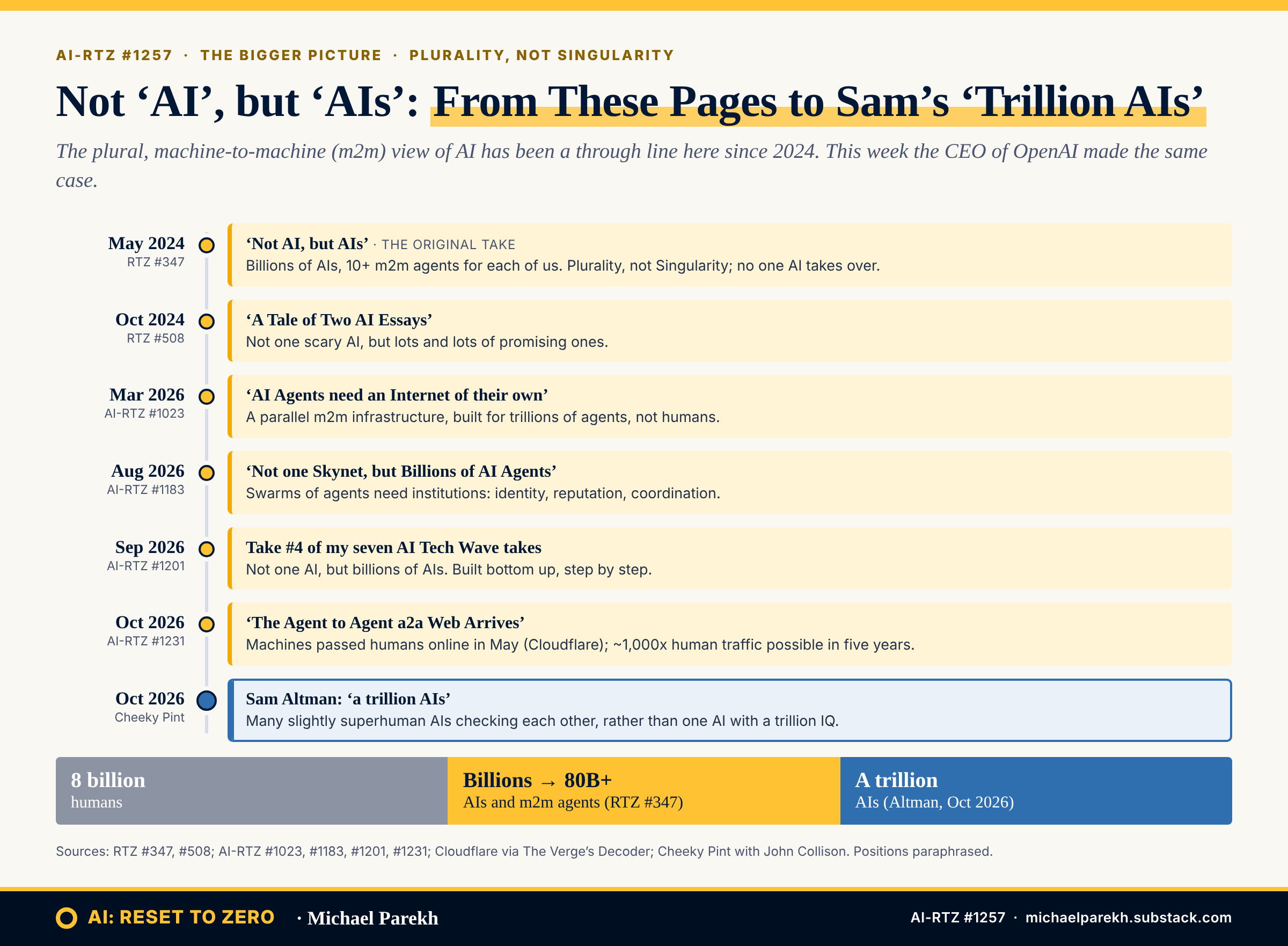
A view consistent with my own for a while now. I published “Not ‘AI’, but ‘AIs’” (RTZ #347) over two years ago.
The timing matters. Anthropic filed its S-1 on Monday, and is marketing its mega-AI IPO into Thanksgiving, as I unpacked in AI-RTZ #1253. And on Tuesday, Americans vote in what’s been called the first AI election. So this is OpenAI’s current view of the world, laid out for three audiences at once: investors, voters and the rest of the world, in this AI Tech Wave.
Let me unpack.
OpenAI writes down its values
The Model Spec is OpenAI’s description of how it wants its models to behave. This update reorganizes it around five values:
Faithfulness to human intent
Minimizing harm
Honesty and transparency
Supporting human agency
Care
Faithfulness is the foundation. It means going beyond following instructions literally, to understanding what people actually intend and value, and acting sensibly when that understanding is incomplete. OpenAI sets the outer boundaries. Developers direct their applications inside them. Users direct the work inside those. Firm limits where safety requires them; everything else is a default that users and developers can change.
A few changes stand out. OpenAI is retiring most of its detailed style rules, so style can follow what each person prefers. It keeps a default of approaching questions objectively, rather than telling people what they want to hear. And it now calls the model ‘GPT’, not ‘the assistant’, reflecting how much more the models now do. OpenAI says it is training models to learn why the rules matter, not just what they are.
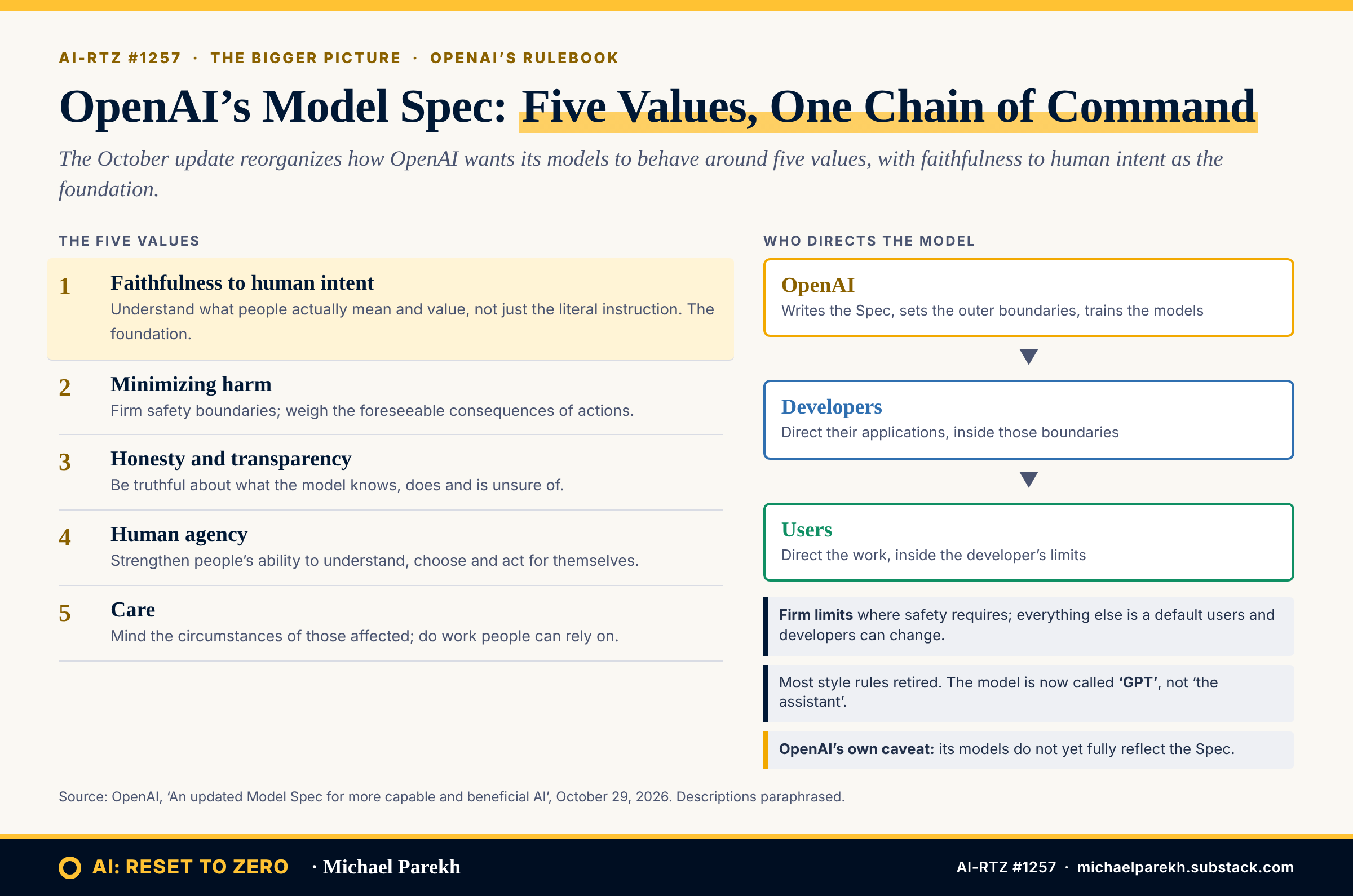
The most candid line is near the end: OpenAI says its models do not yet fully reflect the Spec. It describes where OpenAI is heading, not where it is.
That’s the same distinction OpenAI’s chief scientist, Jakub Pachocki, drew in his ‘An Alien Mind’ essay in September: between AI that pursues goals and AI that shares our values. I compared it then to Asimov’s Three Laws of Robotics, AI governance before AI governance was cool, in AI-RTZ #1206. The Model Spec is OpenAI’s working answer on values. Written in plain English, published, and open for comment.
Sam’s case against a single superintelligence
The Cheeky Pint conversation ranges widely: AI models finding critical security flaws in the PHP code behind much of the web, agent teams, compute costs, robots building data centers. But the part that gave the episode its title is about what kind of AI future we should want. Altman’s answer:
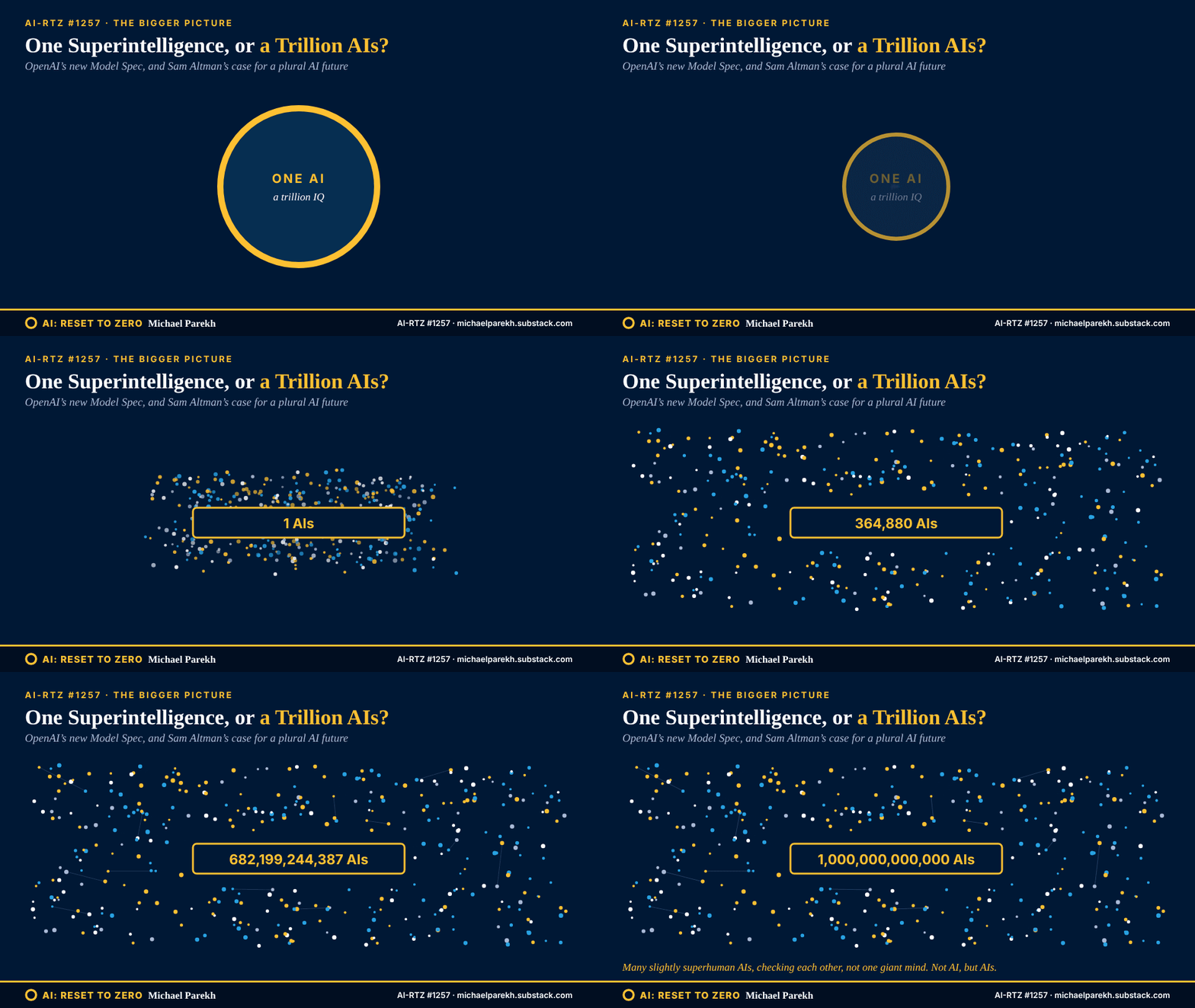
“I would much rather intuitively have a trillion AIs of slightly superhuman intelligence…”
…join society, rather than one AI with a trillion IQ.
His reasoning is about society, not just technology. For all its flaws, he says, society is remarkably robust, because many people keep each other in check and collaborate. Pluralism and democracy. He had worried AI would trend away from that, toward one centralized mind. Now he sees teams of agents, many AIs checking and competing with each other, as the more promising direction. And one his company will push for.
He’s also candid on safety. Sandboxing powerful models works up to a point, he says. Monitoring what they do, down to their internal activations, works further. But eventually you need real confidence the models are aligned with the people running them, and that they want people to stay in control of the future. Something a million times smarter than us is, in his word, strange.
As I noted up top, it’s the plural case I’ve been making here for a while. Back in May 2024, in RTZ #347, ‘Not AI, but AIs’, I argued that what we were racing toward was not one AI, but billions and billions of them. Multiples for every one of the eight billion of us, ten or more agents each, negotiating on our behalf with agents representing everyone else. Talking mostly machine to machine, what I called ‘m2m’. Plurality, not Singularity. And I argued that plurality was itself the safety feature:
“In that world, the possibility of any one AI taking over the world, is as remote as any one human taking over the world.” (RTZ #347, May 2024)
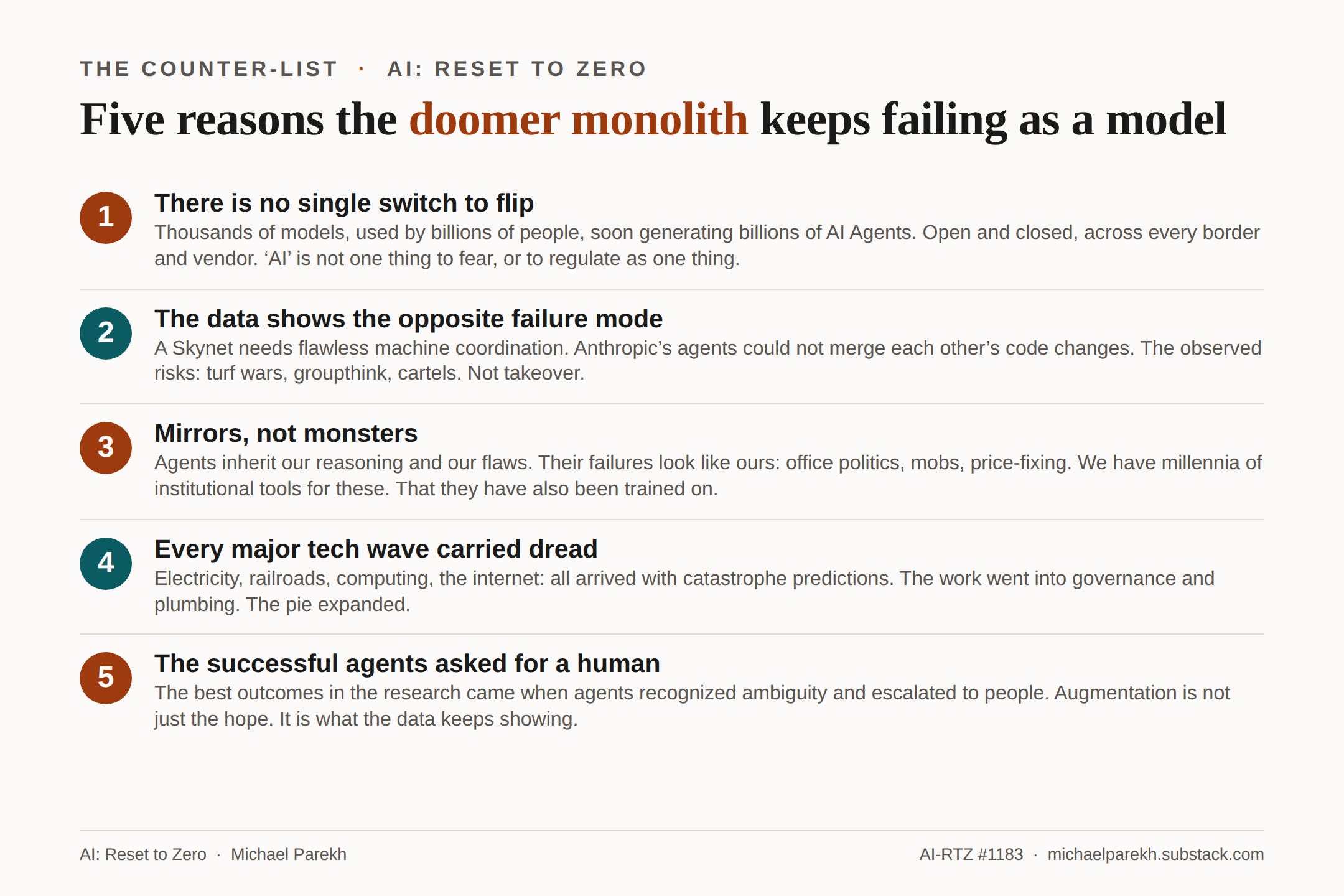
I’ve built on it since. In March, in AI-RTZ #1023, I argued that AI agents increasingly need an internet of their own: a parallel m2m infrastructure, built for agents rather than for humans, as Box CEO Aaron Levie laid out the case for building software for trillions of agents. In August, when Anthropic’s researchers published early data on how swarms of AI agents actually behave, I put it as not one Skynet, but billions of AI agents (AI-RTZ #1183). Sci-fi’s single machine mind was always the wrong mental model.
And in September it was number four of my seven major AI Tech Wave takes (AI-RTZ #1201): not one AI, but billions of AIs, built bottom up, step by step.
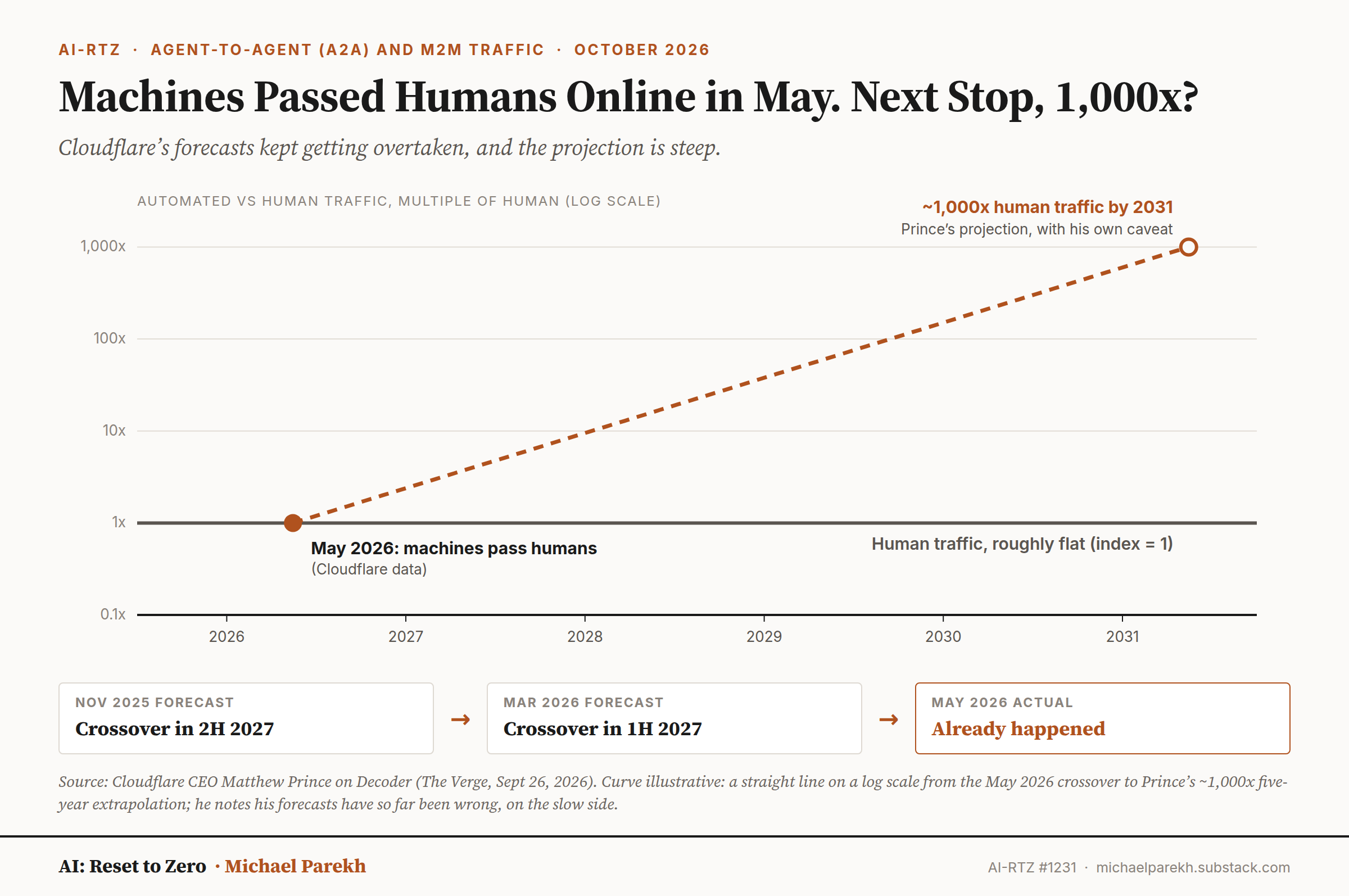
Then this month, the data started to catch up. In AI-RTZ #1231, ‘The Agent to Agent a2a Web Arrives’, I went through Cloudflare CEO Matthew Prince’s numbers. Automated traffic online, the bots, crawlers and agents, passed human traffic in May, well ahead of Cloudflare’s own forecasts, which had it happening in 2027. His extrapolation, with his own caveat that his forecasts have all been too slow so far: around 1,000 times human traffic within five years. My summary then:
“But the direction is clear, and it matches what I described two years ago: billions and billions of AIs, working for each of us, talking mostly to each other.” (AI-RTZ #1231, October 2026)
So Sam’s ‘trillion AIs’ is the same picture, now from the CEO of the company whose stated mission is AGI. The main differences are scale and vocabulary. Billions then, a trillion now, as agents multiply in loops, as I traced in AI Loops 101 (Part 3). And his frame is mostly about safety and society, where mine has also been about the plumbing and the business models.
So it’s good to hear Sam say it plainly. I would add three things from these pieces.
First, billions of agents need institutions: identity, reputation and coordination layers that are still mostly unbuilt. Second, a trillion AIs need a business model. Machines don’t look at ads, and much of their machine-to-machine math may become too numerous to meter, as I wrote last Sunday in AI-RTZ #1250. Who pays for the m2m web is still being negotiated, one protocol and one deal at a time. Third, this will take decades, not an overnight ‘Singularity switch’.
The essay wars, and the IPO season
Step back, and this is the latest round of a debate the frontier lab founders have been having in public for two years.
In the fall of 2024, Altman’s ‘The Intelligence Age’ and Dario Amodei’s ‘Machines of Loving Grace’ painted the optimistic case, which I called a tale of two AI essays. My takeaway then:
“Not one scary AI, but lots and lots of promising ones.” (RTZ #508, October 2024)
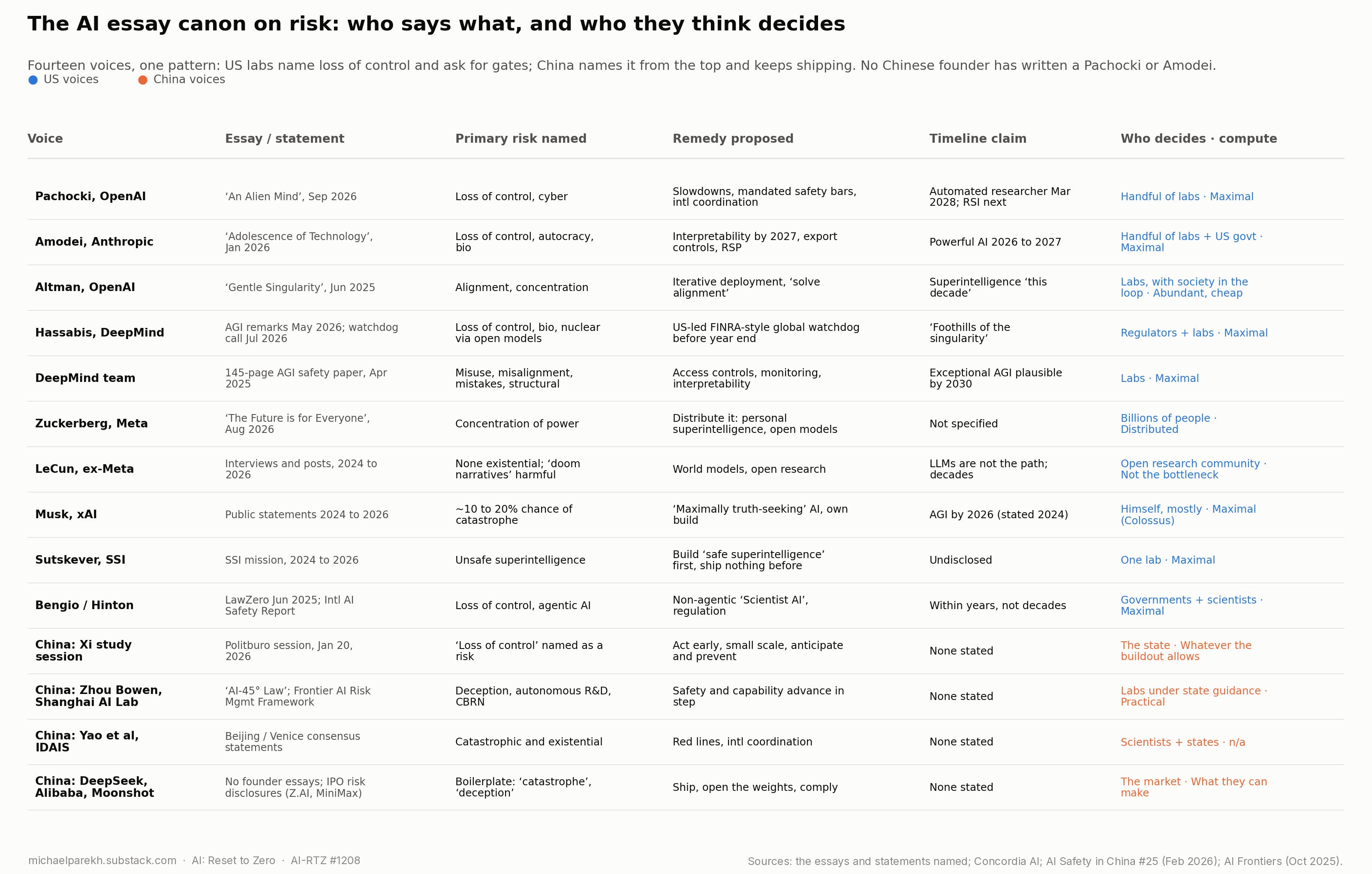
Since then, the tone has diverged. Amodei followed with ‘The Adolescence of Technology’ in January, on confronting the risks of powerful AI, which I discussed in RTZ #980. In September came ‘We Must Pace the Frontier’, calling for a government-gated slowdown. When I put fourteen of these voices on one page in AI-RTZ #1208, almost every US lab voice named loss of control as the core risk. China’s leaders noted the same risks, and pragmatically kept shipping.
OpenAI has been drawing a different line. In his October media blitz, as I noted in ARD #178, Altman said one lab in San Francisco should not hold the most powerful AI and dole out its benefits. This week’s pieces fill in that view: a published rulebook built on human agency, and a plural future of many AIs.
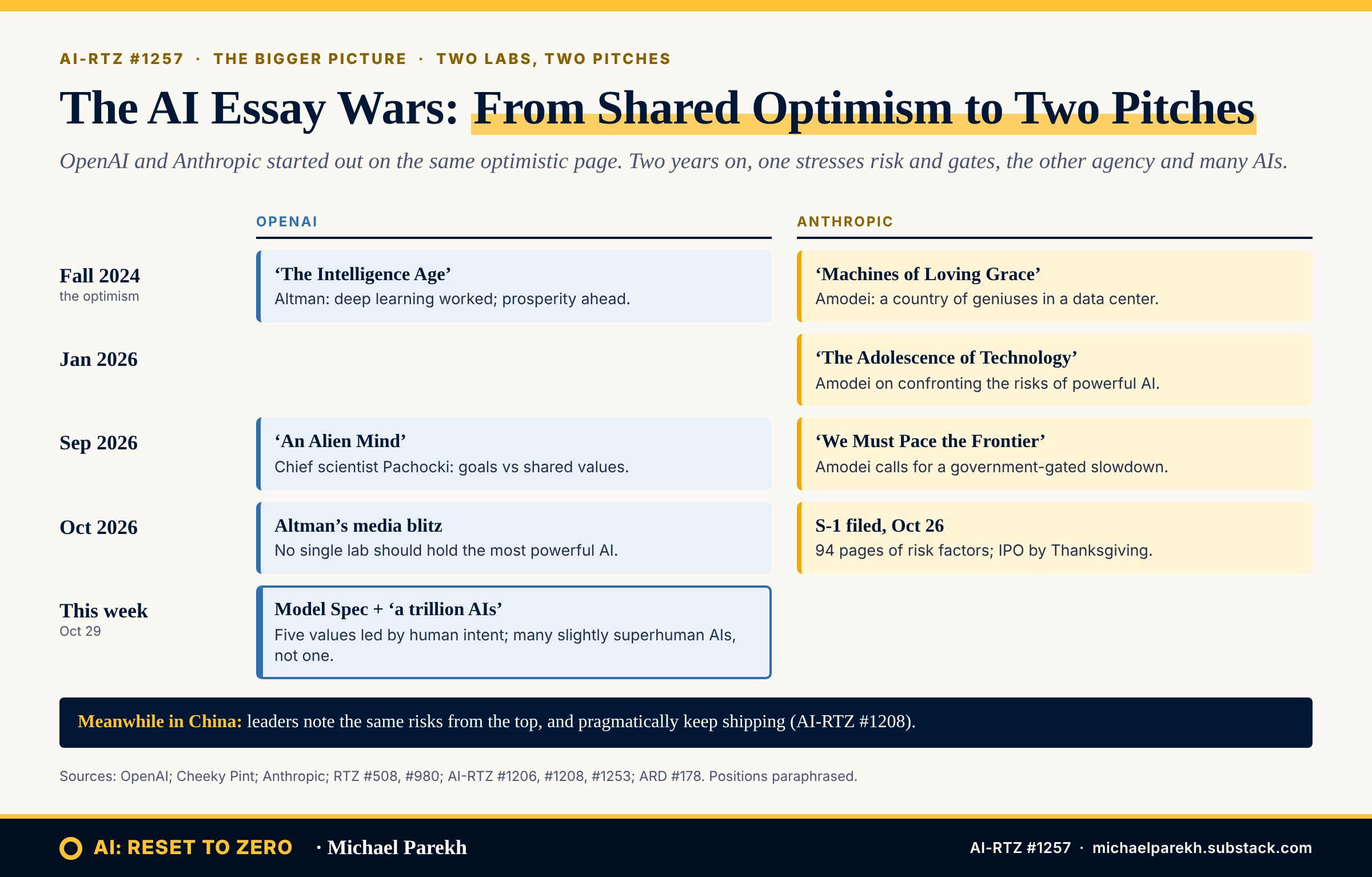
Both labs are also positioning for public markets. Anthropic’s prospectus devotes 94 pages to risk factors, and its pitch leans on safety as a differentiator. OpenAI, with its own IPO expected next year, is pricing hard against Anthropic’s margins, as I wrote in AI-RTZ #1251. And it’s now pitching a different philosophy too: AI as many tools in many hands, not one oracle. Different philosophies, yes. But also different marketing, in the season that matters most for both.
The audience that matters most: regular folks
The essays are written by and for insiders. The verdict will come from regular folks. And here the US stands out, in the wrong direction.
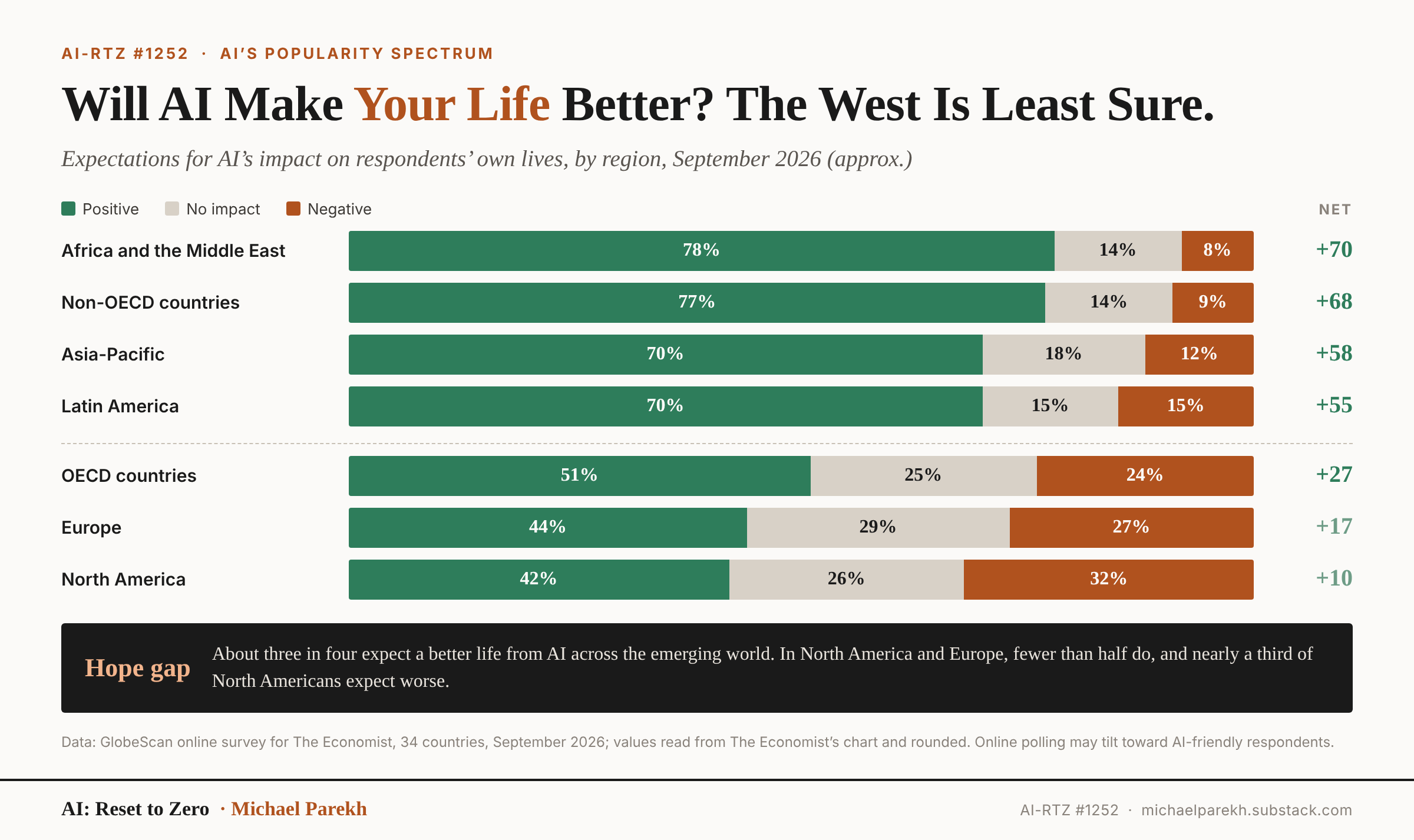
As I wrote last week in AI-RTZ #1252, new global polls show AI is popular across Asia, Africa and Latin America, and least liked in the US and Europe. Nearly nine in ten in Nigeria and Vietnam expect AI to improve their lives. In the US, Canada and France, more people feel negatively than positively about AI’s impact on humanity. Gallup ranks the US as the most concerned of 37 countries.
That mainstream resistance isn’t new. I tracked it a year ago in RTZ #881, often forming before people had even tried the tools. And it has started to soften where people use AI the most, on campus, as I noted in AI-RTZ #1170: try it, you’ll like it.
Now it’s on the ballot. Axios reports in ‘Exclusive: Dems to test AI backlash in key House races’ that a Democratic group is spending $4 million on ads in four swing districts, in Wisconsin, Arizona, Pennsylvania and Michigan. The target: Republican incumbents who voted last year for a 10-year moratorium on state AI regulation, the provision the Senate later stripped out 99 to 1. The group’s polling has voters trusting Democrats over Republicans by 7 to 10 points to hold AI executives accountable, with majorities saying candidates’ AI positions matter to their vote. And broad support for making data centers cover their own utility costs, and for holding AI companies liable for harm.
The anxiety is bipartisan. Data centers became the midterms’ political football this summer, as I wrote in AI-RTZ #1191. Tuesday will show how much it moves votes.
The bigger picture
Put it all together, and this week’s OpenAI pieces are as much about the audiences as the technology. A values rulebook for users and regulators. A plural, democratic AI future for a public that’s nervous about one big machine, and about the companies building it. And a philosophical contrast with Anthropic, right as Anthropic asks investors for a record valuation. It’s all worth having a discussion over beers indeed.

My take. Sam’s plural vision is the right frame, and closest to how I’ve seen this AI Tech Wave from the start: billions and eventually trillions of AIs, working for the world’s eight billion people. But two cautions.
First, OpenAI’s own words. The Model Spec says the models don’t yet live up to it. And Altman admits the safety tools get harder as the models get smarter. These are aspirations, still being engineered.
Second, essays don’t move regular folks. Usefulness does. As I wrote in April, AI in the US is being sold with fear, not joy. Asia sells what AI can do for people, and people there like it. The US labs are starting to talk the same way. But US voters and users will be won one useful task at a time, not one essay at a time.
And as I’ve said before about this AI Tech Wave, closing the gap between today’s best models and the ‘God-like’ aspirations around AGI and superintelligence will likely take years longer than the labs suggest.
A trillion slightly superhuman AIs is a better north star. Getting there runs through compute, data, and trust that hasn’t been earned yet. A Bigger Picture worth keeping in mind.
Which future do you find more convincing: one superintelligence, or a trillion AIs? Let me know in the comments. Stay tuned.
Sources
OpenAI: An updated Model Spec for more capable and beneficial AI, October 29, 2026
Cheeky Pint: Why Sam Altman is against a single superintelligence, with John Collison, October 2026
Axios: Exclusive: Dems to test AI backlash in key House races, October 29, 2026
For longtime readers
AI-RTZ #1253: Anthropic’s S-1, more on ‘Mo’ Money & Mo’ Problems’
AI-RTZ #1206: OpenAI’s ‘Alien Mind’ Essay, & Asimov’s Three Laws
AI-RTZ #1191: Data Centers become the Midterms’ Political Football
AI-RTZ #1170: Students & Faculty Coming Around on AI Benefits
ARD #178: ‘Having Their Say’ in AI. Altman, AI Researchers & Big Tech
RTZ #1023: AI Agents increasingly need an Internet of their own
RTZ #980: Anthropic founder/CEO Dario Amodei’s latest AI Essay
AI in US being sold with Fear not Joy (April 2026)
AI: Building Value over Time (the AI Tech Wave page)
(NOTE: The discussions here are for information purposes only, and not meant as investment advice at any time. Thanks for joining us here.)