

Nvidia the Kingmaker, a two-part series: Part 1, The Open Source ‘AI Factory’ · Part 2, The AI Banker & Its Next Generation
Nvidia founder/CEO Jensen Huang has been building America an open source AI champion for a while now, as I have written many times.
The latest move in that long game came this week. Reflection, the New York AI lab Jensen personally steered toward open models, released its first open-weight model, Beam, on Monday, per Semafor in ‘Reflection AI unveils an open-source Western answer to Chinese labs’. Axios had the scoop a day earlier in ‘Scoop: Powerful open model is set to shake up AI race’.
It is just the latest step in a bigger narrative in this AI Tech Wave: Nvidia playing ‘Kingmaker’ up and down the AI tech stack, in open source AI versus China, in neoclouds and sovereign AI, and as a global AI banker.

Today, the open source part. Tomorrow, the money and the people. Let me explain.
Reflection’s rocket clears the pad, with Beam
Reflection’s first model is called Beam. The company is positioning it as a ‘workhorse’ that performs better than other Western open models, per Semafor. CEO Misha Laskin says it is particularly strong at coding and agentic tasks, and needs three to four times less computing power to reason through a problem than comparable open models, making it faster and cheaper to run.
On capability, Beam is comparable to Z.ai’s GLM-5.2, released in June, and approaching Alibaba’s most advanced model, Qwen3.8-Max, which in turn trails the top closed models from OpenAI and Anthropic. That matches what Axios heard: behind the US frontier at first, competitive with the best from China. Other Western open-weight models are set to follow this month. And Reflection is already training its next model, which Laskin says will be much more powerful.
The target customer is clear. Businesses, governments and others building sovereign AI systems that don’t or can’t use Chinese models, but still want to own and control their AI. As Laskin put it to Semafor:
“They don’t really have very good options today.” (Misha Laskin, Reflection CEO, to Semafor)
Beam is also a bid for a seat at the table in Washington. Reflection is working with US and UK government AI safety evaluators to assess the model, and Laskin wants open model builders in the AI regulation debate alongside the closed labs, just as calls for new AI rules grow louder ahead of the midterms.
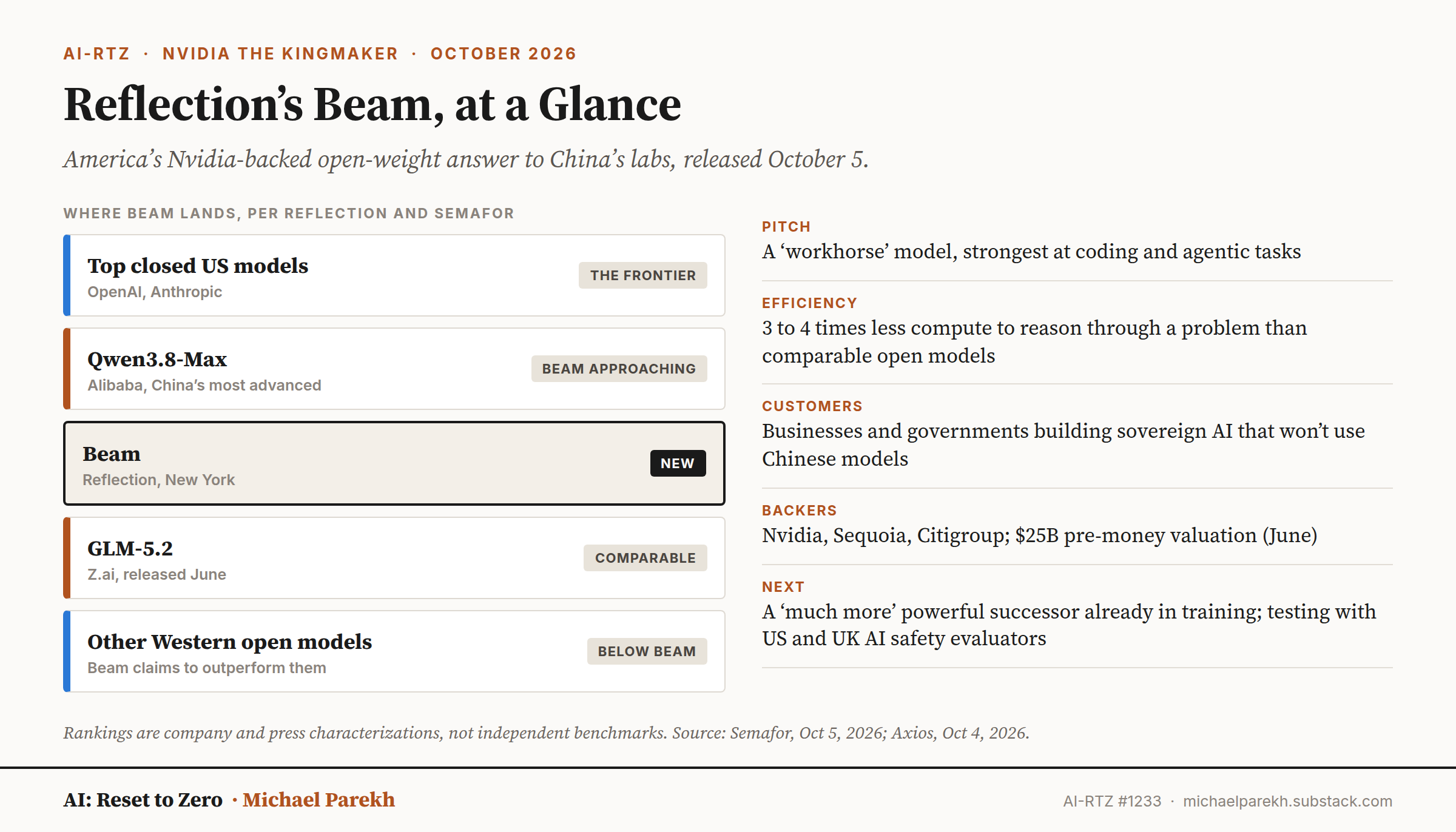
That is notable progress. Back in July, I wrote in ‘Open Source AI Rockets Are Hard’ that Reflection had yet to ship a model nearly a year after Jensen pushed its co-founders toward his vision. Reflection CEO Misha Laskin had compared frontier models to rocket ships, big ones taking time to build. He repeated the line to CNBC again, per Axios. Now the first rocket is off the pad, with more fuel lined up. Reflection has been aggressively locking up compute, including a $6.3 billion deal to rent Nvidia GB300s in SpaceX’s Colossus 2 data center through 2029, and a $1 billion deal with Nebius. Nvidia is Reflection’s lead backer, with about $2 billion invested, at a $25 billion pre-money valuation, per TechCrunch.
The more important part of the Axios piece is what Reflection wants to be, beyond a model. Its goal is to pioneer the ‘AI factory’: a product that lets institutions spin up their own localized AI ecosystems, with their own proprietary data, Reflection’s open models, and their own secured compute.
Hedge funds and trading firms are early fans. And Reflection is testing a sovereign AI factory with South Korea’s Shinsegae Group. As Axios puts it:
“The AI factory has been a core vision of Nvidia CEO Jensen Huang for years.” (Axios)
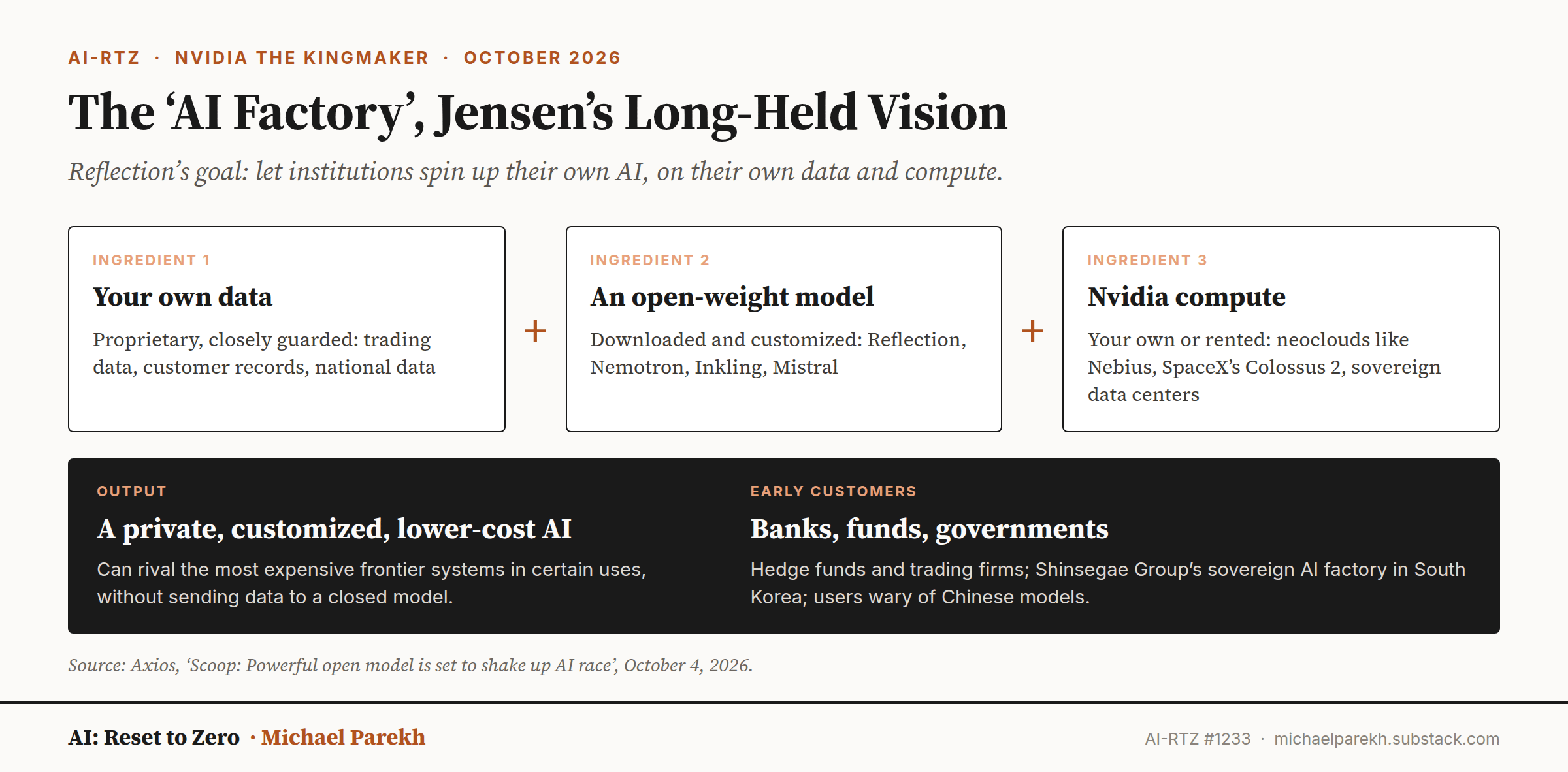
That is the tie that binds the rest of this series. The AI factory is Nvidia GPUs, plus open models, plus a customer’s own data. It needs someone to finance the factory, someone to run it, and governments that want one of their own. More on that tomorrow.
The open source scoreboard, and why it matters
The reason Jensen cares is the scoreboard. China’s open-weight models have taken Silicon Valley by storm, as Axios notes, and I have tracked since RTZ #923, on US companies building on free Chinese models like Alibaba’s Qwen. On platforms that serve many models, open models at times take a majority of usage. But in enterprise use, the higher spending arena of APIs and corporate billing, they are still a small share. And top users like banks and the Pentagon balk at highly capable Chinese models over security risks. That is the opening Reflection and other Western players are trying to fill.
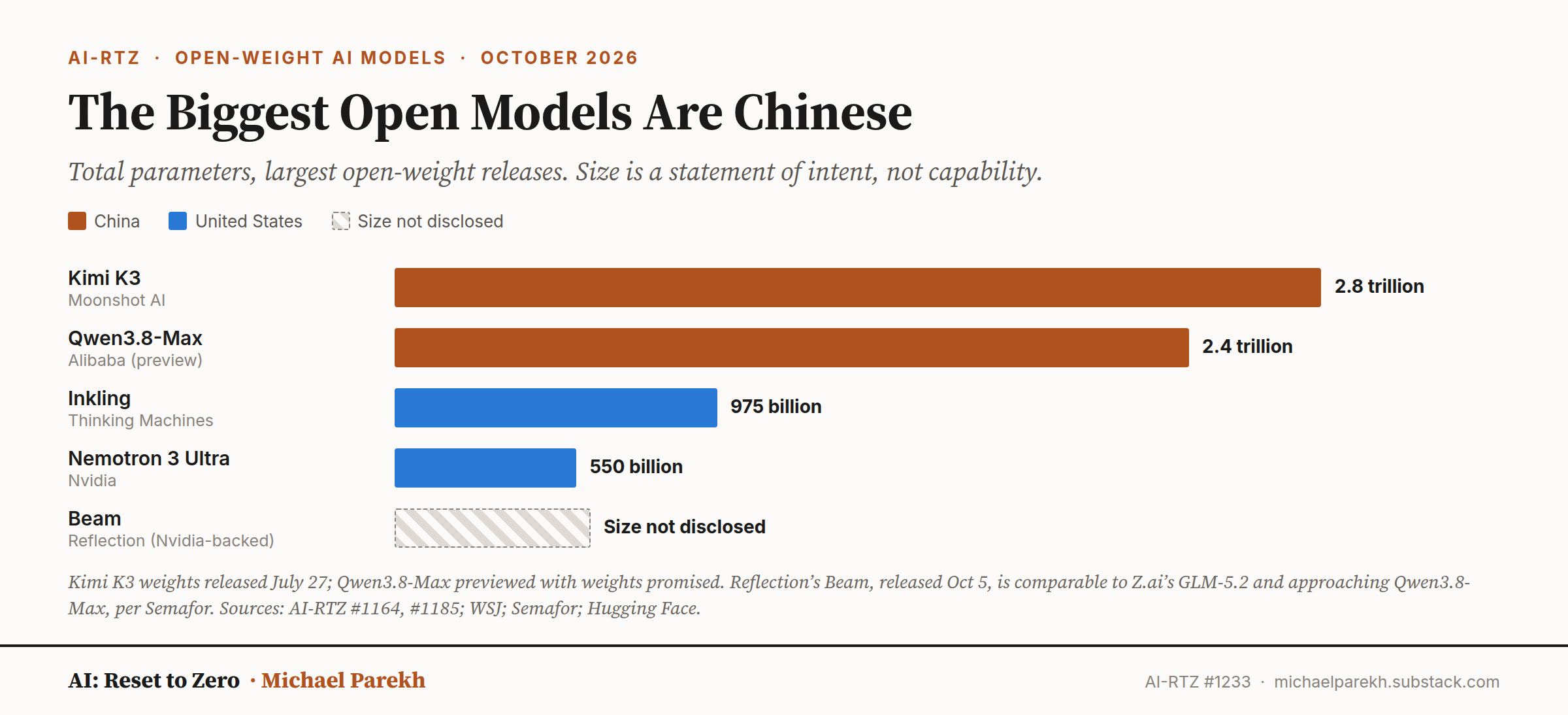
The size gap is stark. As I wrote in July and again in AI-RTZ #1185, Moonshot’s Kimi K3 shipped at 2.8 trillion parameters, and Alibaba previewed Qwen3.8-Max at 2.4 trillion. And Alibaba is already planning 5-10 trillion parameter ‘super-scale’ open source models next as its investments grow in this direction.
The largest American open models, Thinking Machines’ Inkling and Nvidia’s own Nemotron 3 Ultra, are under a trillion. Size is not capability, of course. But it is a statement of intent.
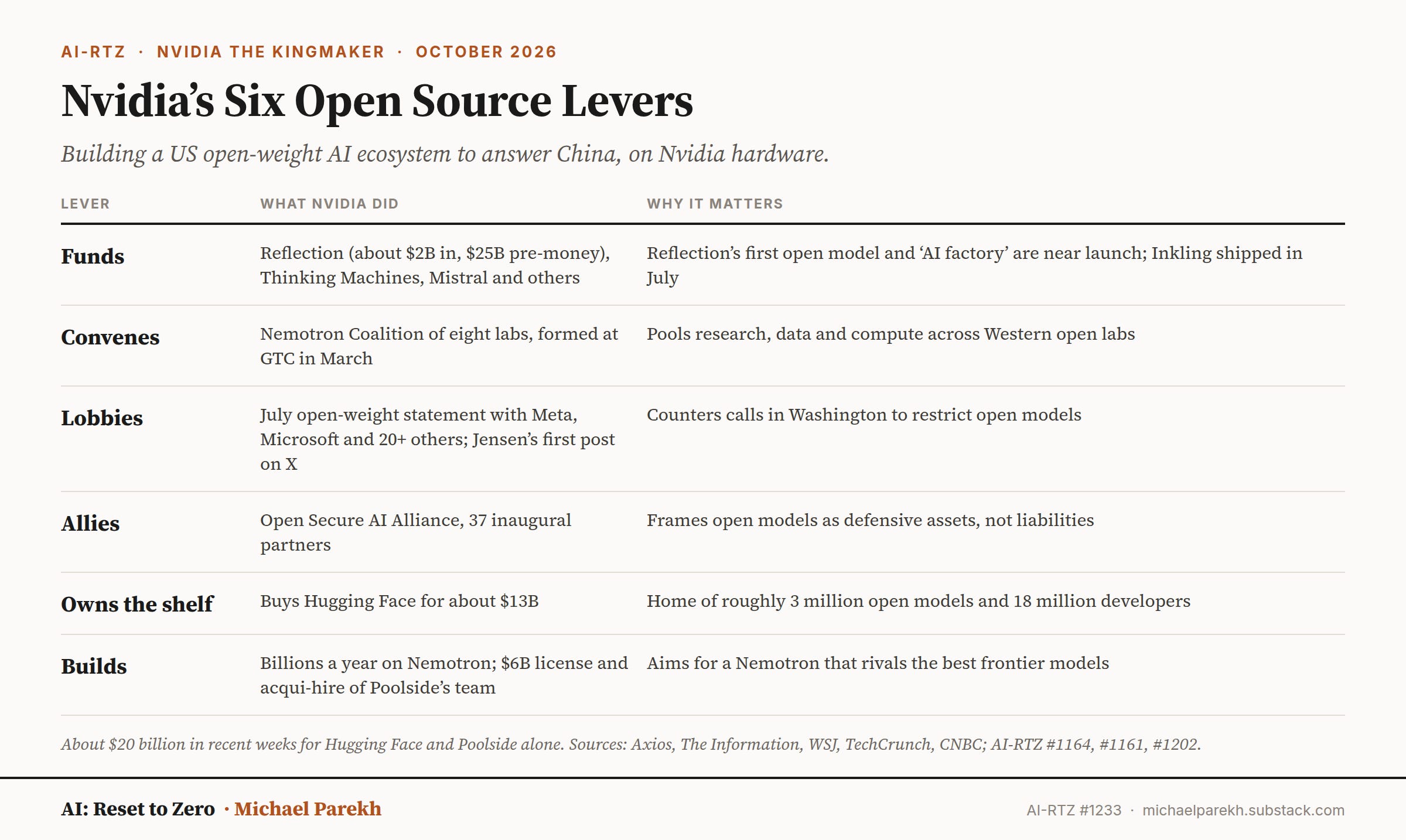
Nvidia’s six open source levers
In July I counted four levers Jensen was pulling at once for open models. He funds, he convenes, he lobbies, and he allies. Since then he has added two more.
He funds: Reflection, Mira Murati’s Thinking Machines, whose Inkling model I covered in AI-RTZ #1149, and Mistral, among others. He convenes: the Nemotron Coalition of eight labs he formed at GTC in March, which I laid out in ‘How Nvidia & Apple can be the US Open Source AI Champions’. He lobbies: the July open-weight statement signed with Meta, Microsoft and others, and his first post ever on X. He allies: the Open Secure AI Alliance, the AI ‘Avengers’ I wrote about in AI-RTZ #1161.
Then he owns the shelf: Nvidia’s roughly $13 billion purchase of Hugging Face, the home of the world’s open models, as I discussed in AI-RTZ #1202. And he builds: Nvidia is spending billions of dollars a year on its own Nemotron open models, per The Information, plus a $6 billion license and acqui-hire of Poolside’s team to build a Nemotron that rivals the best, as I noted on ARD #147. All told, about $20 billion in recent weeks for Hugging Face and Poolside alone.
Why the Kingmaker plays open
Why would the world’s most valuable chip company spend this kind of money on free models? Three reasons, in my view.
First, open models run on Nvidia’s hardware. That is the CUDA playbook, extended up the stack. As I argued in May, Nvidia is fast becoming the operating system of the AI industry, and open models are its apps. Every company that builds its own AI factory on open models is a new Nvidia customer, beyond the handful of hyperscalers.
Second, it is a hedge against the closed frontier. Anthropic and OpenAI are both Nvidia customers and frenemies, both lobbying to restrict Chinese open source, and both building their own chips. A strong US open model ecosystem keeps Nvidia from depending on two or three model makers for its future, much like neoclouds keep it from depending on a few clouds. More on that tomorrow.
Third, it is geopolitics. Jensen has argued for years that America wins by having the world build on its technology stack. If the world’s developers build on Chinese open models, they increasingly optimize for Chinese chips too. Nvidia would rather the world build on American open models, running on Nvidia chips, in AI factories in Seoul, Riyadh, Paris and Austin.
My take
Three things to keep in mind.
First, a model release is a milestone, not the finish line. Beam trails the US frontier, and approaches but does not yet beat China’s best open model, per Semafor. That is still useful. A ‘good enough’ open model plus a company’s own data can rival the most expensive frontier systems in certain uses, per Axios. But rockets are hard, and big ones are harder.
Second, the AI factory is the real product. Banks, trading firms, the Pentagon and sovereign nations want AI on their own data, in their own facilities, without sending it to someone else’s model. That market is made for open models on Nvidia hardware. It is the same pitch Jensen has made for years, and Reflection is one more way to deliver it.
Third, open source is now one of Nvidia’s growth strategies, not a side project. Funding, convening, lobbying, allying, owning the shelf and building its own models all point the same way. Reflection is the latest advancement in that narrative. Tomorrow in Part 2, the other half of the AI factory: the neoclouds, the sovereign AI deals, and the financing Nvidia is arranging to build them, with Jensen’s next generation in key roles.
The Kingmaker keeps making kings, up and down the AI Tech Wave stack. More in Part 2 tomorrow. Stay tuned.
Sources and further reading
Semafor, ‘Reflection AI unveils an open-source Western answer to Chinese labs’, October 5, 2026
Axios, ‘Scoop: Powerful open model is set to shake up AI race’, October 4, 2026
TechCrunch, ‘Reflection inks $1B compute deal with Nebius’, July 14, 2026
For longtime readers
AI-RTZ #1164: Open Source AI ‘Rockets Are Hard.’ Nvidia, Reflection & China
AI-RTZ #1149: Thinking Machines next US open weights AI model entrant
AI-RTZ #1089: How Nvidia & Apple can be the Global, US Open Source AI Champions vs China
AI-RTZ #1161: Nvidia Assembles AI ‘Avengers’, Open Secure AI Alliance
AI-RTZ #1202: Nvidia Buys the ‘Home Shelf’ of Open AI, Hugging Face
AI-RTZ #1185: The Global State of Open Source AI Models (part 2)
RTZ #923: US companies building on Chinese open source LLM AI models
RTZ #1036: Nvidia accelerating role as the AI Computing ‘Kingmaker’
ARD #147: ‘The World on its Shoulders’ in AI. Nvidia’s Mega Week
(NOTE: The discussions here are for information purposes only, and not meant as investment advice at any time. Thanks for joining us here.)
Laskin's line about governments and businesses that "don't really have very good options today" sums up the stakes. A lot of sovereign AI buyers in Europe, the Gulf and Asia have been quietly defaulting to Qwen and GLM because they were the best open weights on offer, and every one of those deployments brings Chinese training choices and content rules along with it. A competitive Western open model that needs a third to a quarter of the compute could change that math fast. Bringing in the US and UK safety evaluators from day one also helps with credibility. Looking forward to Part 2, since Nvidia as banker raises its own questions.
the AI-factory pitch quietly concedes the strategic point: when the recipe is your data + an open-weight model + commodity accelerators, the only scarce inputs left are the ones you own. Weights keep commoditizing and silicon is purchasable, so defensibility migrates to proprietary data, evals, and the muscle to operate the thing yourself - which is exactly the case for owning the stack over renting it: https://seldondance.substack.com/p/the-maoe-gambit-own-your-ai-stack