

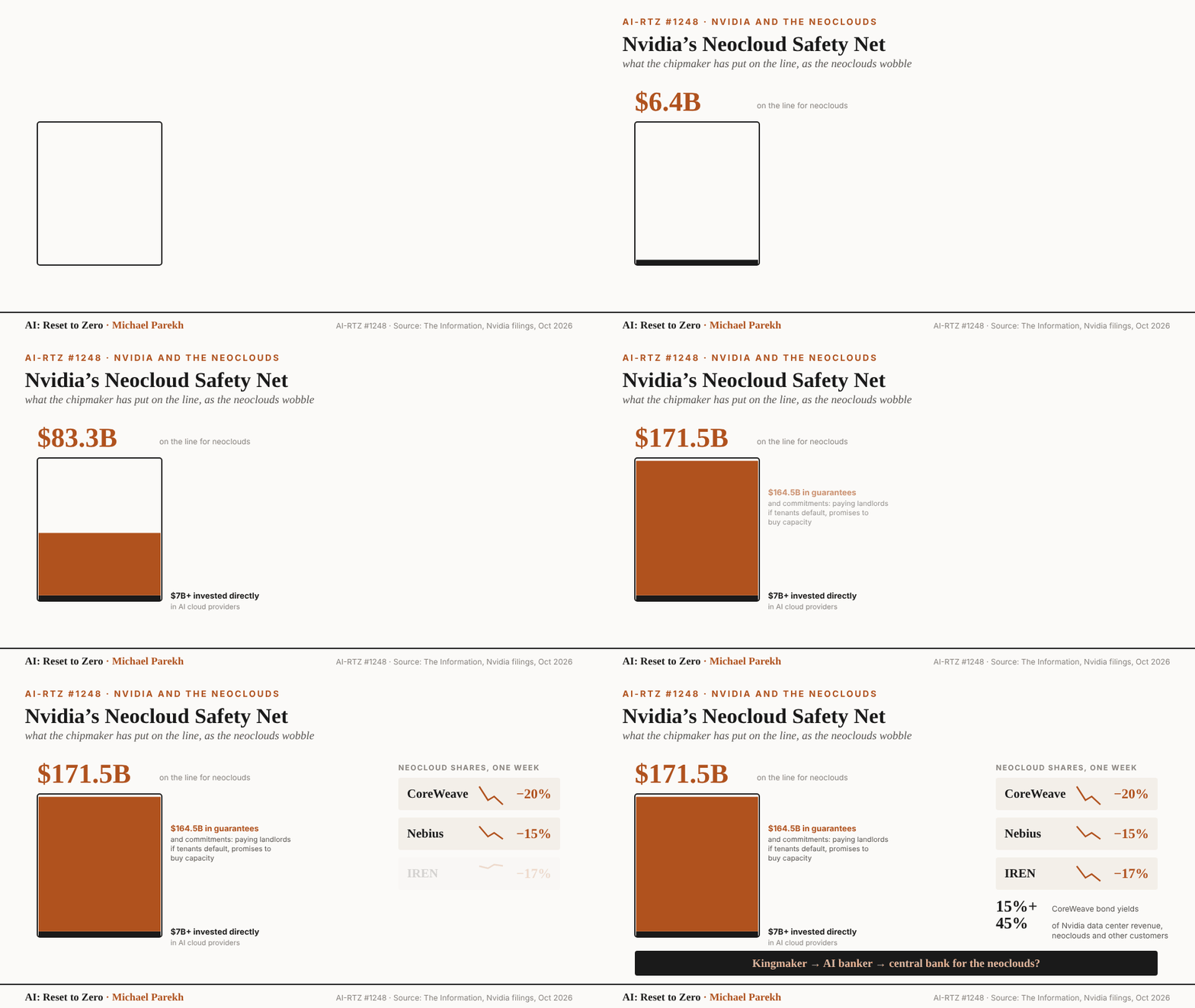
This week, the AI build-out story turned decisively from a technology story into a financing story. The neoclouds, the newer AI data center providers built behind the big clouds, took a beating in the stock and bond markets. And the company with the most riding on them, Nvidia, now turns out to have more than $170 billion on the line to keep them going. Let’s unpack both, in this AI Tech Wave.
Nvidia’s $170 billion on the line
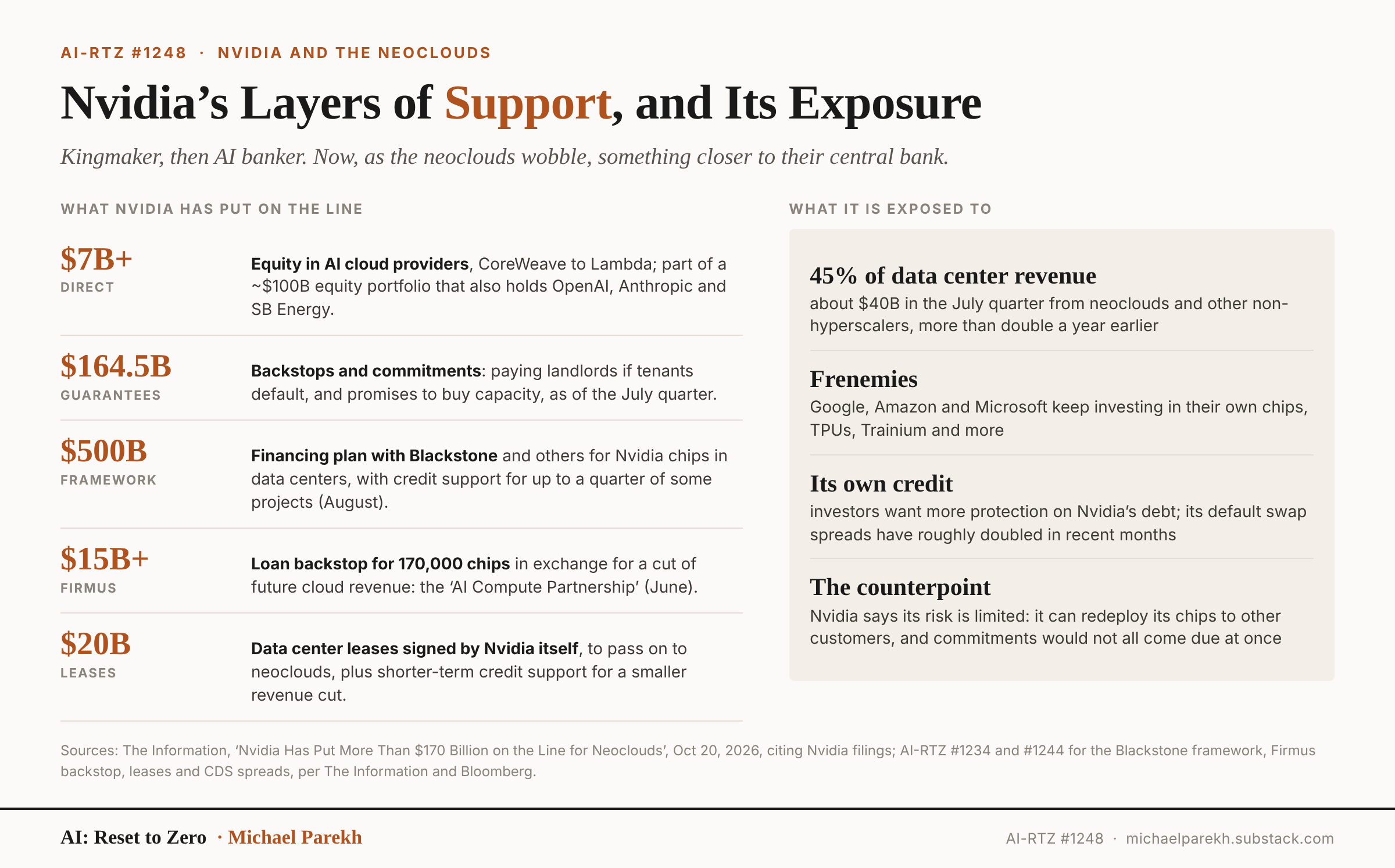
The Information tallied it up earlier this week in ‘Nvidia Has Put More Than $170 Billion on the Line for Neoclouds’. As of its July quarter, Nvidia had disclosed as much as $164.5 billion in guarantees and other commitments to support new data centers, including agreements to pay landlords if tenants default on their leases, and promises to buy capacity. On top of that, it has invested or agreed to invest more than $7 billion directly in AI cloud providers. Those stakes sit inside a broader Nvidia equity portfolio worth nearly $100 billion, which also includes data center developer SB Energy and the big AI labs, OpenAI and Anthropic.
The mechanics matter. Nvidia’s equity helps the neoclouds cover the part of GPU purchases and project costs that lenders typically will not finance in full. Its lease guarantees and capacity commitments make it easier to finance the data centers, and the Nvidia chips inside them. The Information’s description of Nvidia’s role is apt: something of a central bank for the companies expanding the market for its chips beyond the big tech giants.
The timing is what makes this notable. Shares in CoreWeave, Nebius and IREN tumbled last week. Nvidia-backed Firmus and Lambda have pulled or postponed IPO efforts, while SB Energy and Nscale made their IPO filings public last month but have not moved ahead. Financiers of some data center projects are getting jumpier. So the question becomes how much further Nvidia goes to shore up confidence. Nvidia declined to comment to The Information, but its CFO Colette Kress told analysts on its August earnings call that Nvidia’s exposure from backing AI companies is manageable:
“Risk is limited” (Colette Kress, Nvidia CFO, August 2026 earnings call, per The Information)
Her reasoning: Nvidia can redeploy its chips to other customers. And its commitments would not all come due at once, even if major cloud customers defaulted.
As for how much further Nvidia will go, we got an early answer this week. Nvidia is in talks to invest hundreds of millions of dollars in Firmus, the Australian neocloud that pulled its IPO early this month, The Information reported on Tuesday. Firmus had reportedly sought $5 billion at a $30 billion valuation in that listing, and is now trying to raise at least $2 billion privately. Nvidia has been in its last three funding rounds, and in June agreed to backstop Firmus’ purchase of an estimated $15 billion of server racks holding at least 170,000 of its GPUs. The talks could still change or fall apart. Nvidia is also adjusting its terms, now offering shorter-term credit support in exchange for a smaller cut of neocloud revenues. It is even helping neoclouds find sites with available power, through a team co-led by Nico Caprez, Jensen’s son-in-law, whose rise I covered in my piece on Nvidia’s next generation. And the neoclouds are not all in the same boat: Jensen said last week that CoreWeave would not need a further Nvidia backstop, while CoreWeave’s CEO privately blamed smaller, younger neoclouds like Firmus for hurting the sector’s reputation.
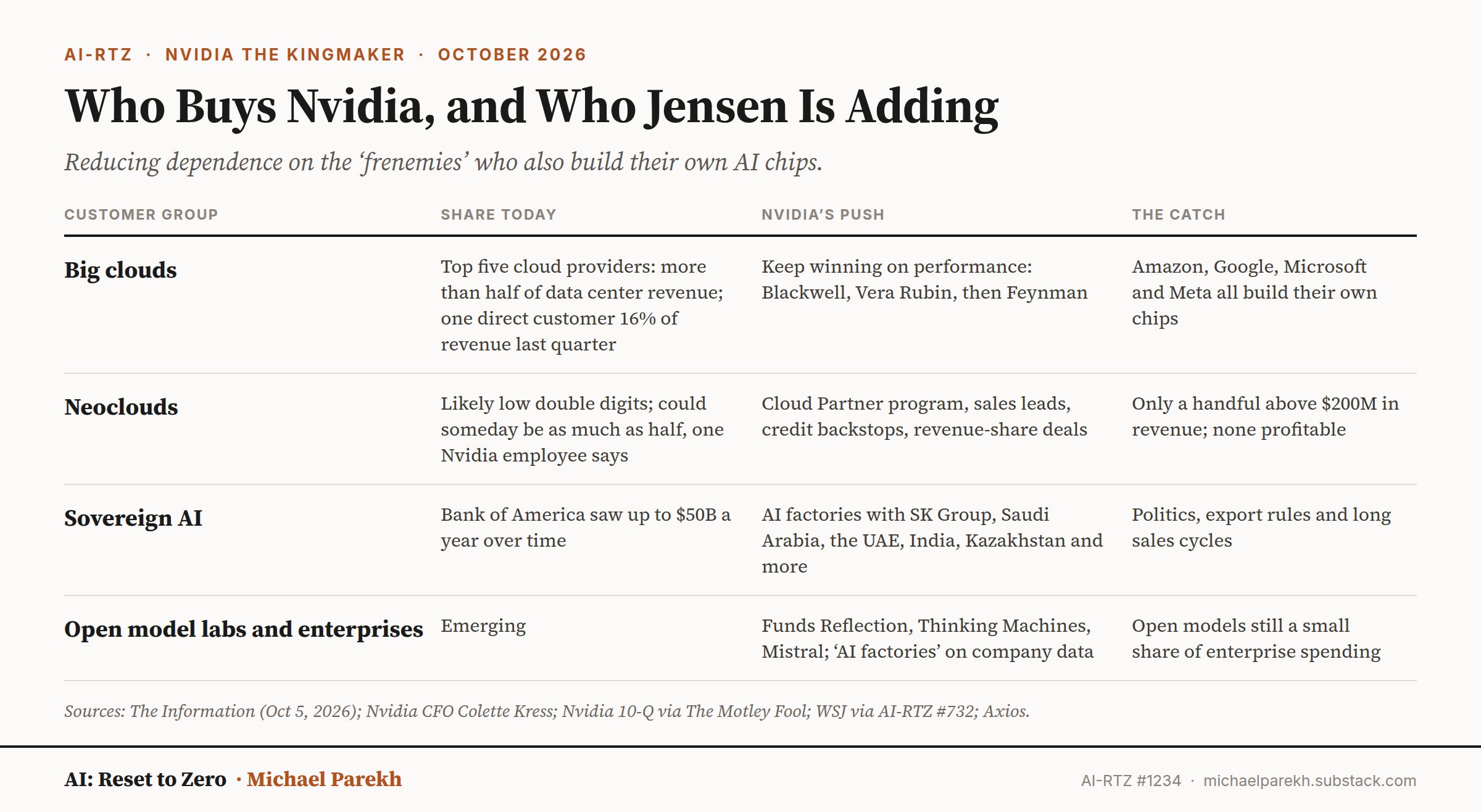
The stakes for Nvidia are real either way. Its non-hyperscaler customers, mostly neoclouds plus large enterprises, were 45% of its data center revenue in the July quarter, about $40 billion, more than double a year earlier. That is the customer group Jensen Huang has been building on purpose, as I laid out two weeks ago in AI-RTZ #1234:
From Kingmaker to AI banker to central bank
Longtime readers have watched this role build, step by step. Back in December 2024, in ‘Rise of the AI data center Neoclouds’, I described a new cluster of companies building furiously behind the big clouds, backed in some cases by Nvidia itself, with Wall Street lending billions against their Nvidia chips as collateral. Even then, critics were pointing out that chips are a depreciating asset, not an appreciating one.
In March 2025, on the eve of CoreWeave’s IPO, I wrote about Nvidia’s rocket fuel propulsion of CoreWeave: an early equity investment, hundreds of thousands of GPUs, and ‘Project Osprey’, a $1.3 billion deal for Nvidia to rent back its own chips from CoreWeave. Nvidia was CoreWeave’s second-largest customer that year.
This March, in RTZ #1036, I called Nvidia the AI Computing ‘Kingmaker’, using its war chest to back promising startups and key customers who would otherwise struggle to afford its chips. In August, in AI-RTZ #1171, it graduated to ‘Uber AI Investor & Banker’, with more than $750 billion of deals in the works, including backstopping OpenAI’s data center leases. My take then:
“Circular financing, in other words, becomes a pathway to recognized revenues. For OpenAI on its way to the mega-AI IPO, and for Nvidia across that trillion-dollar pipeline. Bookings become buildings become billings.” (AI-RTZ #1171, August 2026)
And in AI-RTZ #1234 this month, I laid out why Jensen does it. The ‘Frenemies’ problem: Nvidia’s biggest customers, Amazon, Google, Microsoft and Meta, all buy its chips while building their own. The neoclouds, and sovereign AI governments, are his answer. Alternative customers that run on Nvidia, financed in part by Nvidia, through the $500 billion financing framework with Blackstone and others, revenue-sharing backstops like the one for Firmus, and an effort to turn GPUs into a financial asset class, like aircraft or shipping containers, that lenders can value and trade.
What is new this week is the scale of the commitments, and the stress on the companies they support. The Kingmaker became the AI banker. With $170 billion on the line, it now looks more like the neoclouds’ central bank. And central banks get tested in exactly the kind of week the neoclouds just had.
CoreWeave, the bellwether
That stress is concentrated in one name. The Information’s companion piece, ‘How CoreWeave’s Debt Binge Brought a Moment of Reckoning’, is the best history yet of how CoreWeave got here, and why its fate has become a bellwether for whether the whole AI build-out can be financed.
It starts in early 2023, at Blackstone’s Park Avenue headquarters, where Steve Schwarzman and his team debated whether to lend billions to a little-known data center developer they had turned down months earlier. CoreWeave had just landed a multiyear Microsoft contract and needed $2.3 billion for Nvidia GPUs and a data center. It had generated only $16 million of revenue the year before. Several executives had misgivings. Blackstone did the deal anyway, structured on Microsoft’s ability to keep paying, with the GPUs as collateral. That became the template for everything CoreWeave did after: sign a contract with a big customer, borrow against it, and repay the loan out of the contract revenue in about two and a half years. Then borrow more corporate debt on top to cover what the project loans do not.
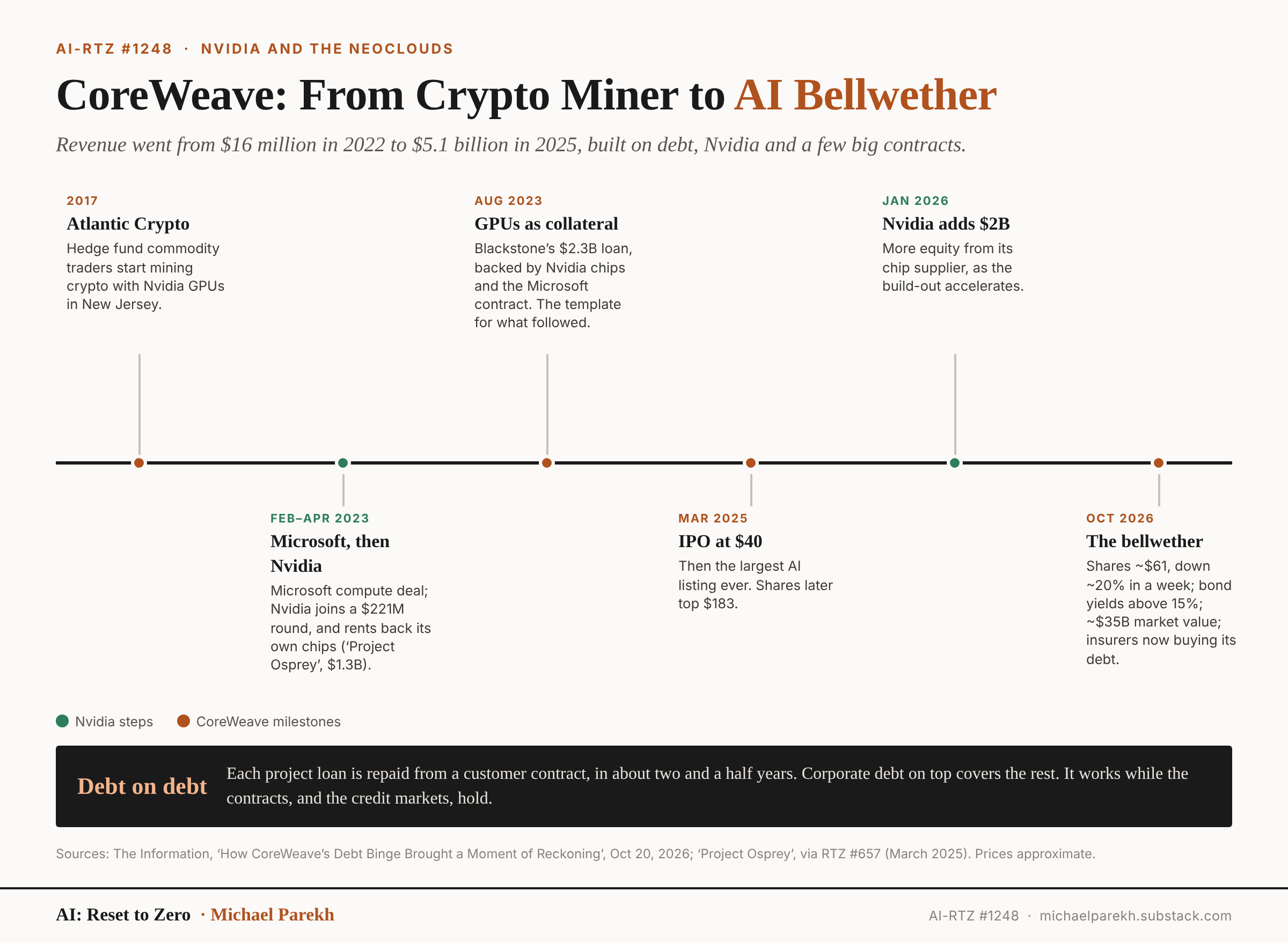
It worked spectacularly. CoreWeave went public in March 2025 at $40 a share, then the largest AI listing ever, and topped $183 in the months after. It now has contracts with Microsoft, Meta, OpenAI and others, generated $5.1 billion of revenue last year, and is worth about $35 billion. Nvidia added another $2 billion of equity this January.
But in the week to Monday, the stock fell from nearly $80 to just over $61, about 20%, while Nebius lost 15% and IREN 17%. Yields on CoreWeave’s debt climbed above 15%, up from nearly 15% when I discussed it in ARD #184. There was no single bad announcement. Rising Treasury yields, a hot September inflation print and the prospect of Fed rate hikes all raise what CoreWeave pays to keep growing. Its CEO, Mike Intrator, told staff the market was misunderstanding the company. Elon Musk reposted a chart of CoreWeave’s bond yields with a one-word reaction. And Ben Horowitz, on the All-In podcast, described CoreWeave’s model as a kind of Rube Goldberg financial machine, which is why Andreessen Horowitz has largely stayed away from the neoclouds. More on Horowitz, and his own Loudcloud lesson, in Sunday’s Part 4 of AI Loops 101.
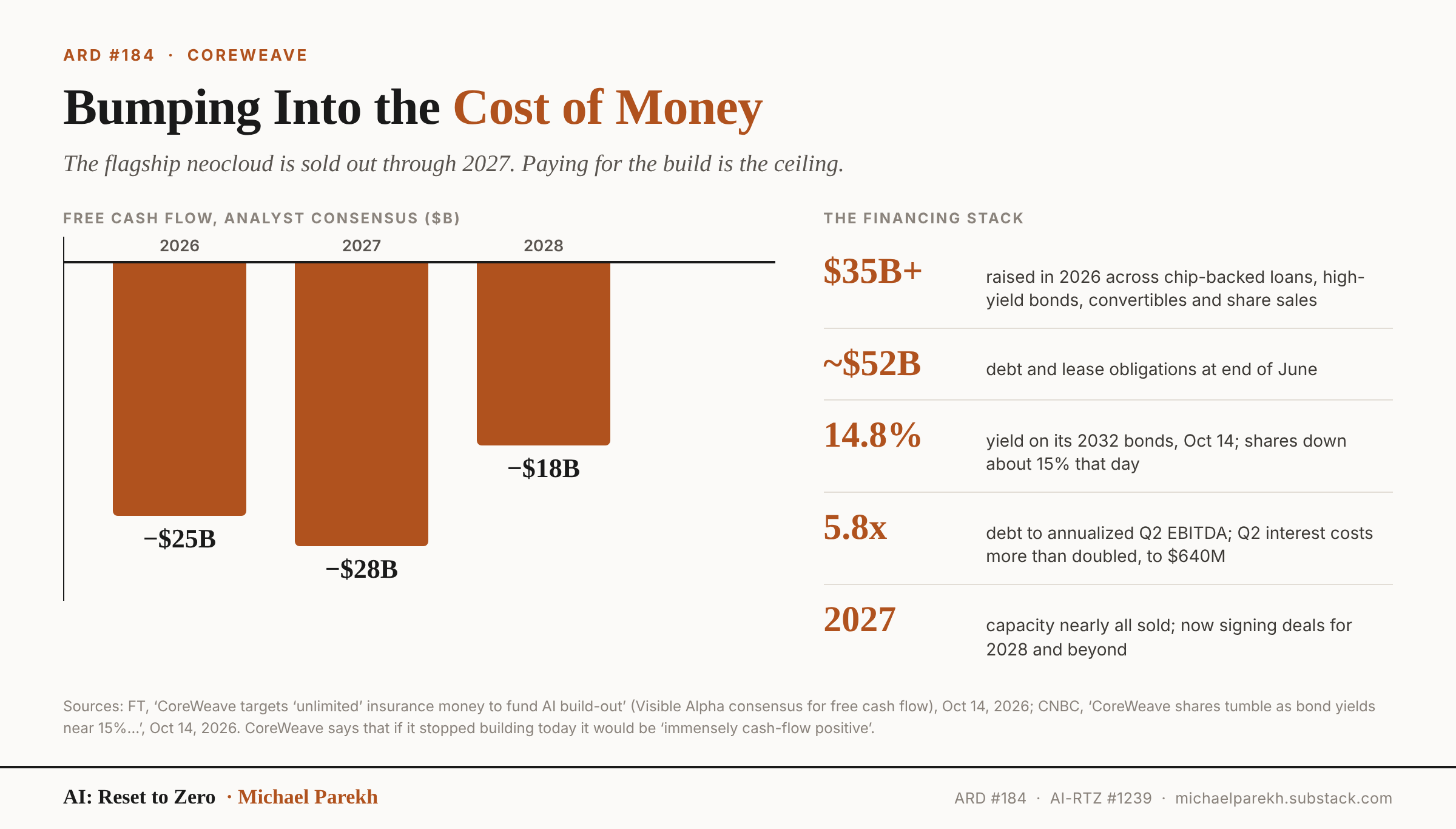
Two details in the piece stood out to me. First, CoreWeave has become the market’s hedge for the whole AI trade. Investors with big private stakes in the frontier labs short its stock or buy its credit default swaps, because it is one of the few liquid ways to bet against the build-out. Second, even CoreWeave’s bankers at Goldman Sachs, my former firm and one of its IPO underwriters, reportedly could not find a fundamental reason for the swoon. Goldman’s analysts upgraded the stock to a buy on Monday. And Jensen Huang said publicly last week he was optimistic about CoreWeave’s strength, which briefly arrested the slide.
Meanwhile, Blackstone has been bringing in a new set of lenders: insurers, with their deep pockets and long time horizons, who bought more than $740 million of a CoreWeave project loan tied to a Meta contract. CoreWeave’s financing chief told the FT he wants access to the insurers’ ‘unlimited’ pools of capital, as I noted in ARD #184. And a Jefferies strategist sums up where this goes next: with credit getting pricier, the neoclouds will increasingly need to sell stock.
My take: a lender of last resort, with limits
Three things to keep in mind.
First, this is still a financing cycle more than a demand cycle. As I said on Monday in AI-RTZ #1244, demand for AI compute is still running ahead of supply at the frontier. CoreWeave just told customers it would raise prices on its core product, GPUs by the hour, another 10%. Anthropic’s draft S-1, which I went through on Wednesday in AI-RTZ #1246, shows one of the biggest AI compute buyers asking for more capacity than its partners will provide. What is cracking is the cost of money for the most leveraged builders, as rates turn up.
Second, Nvidia can afford to be the backstop, and it has every reason to be. Keeping the neocloud channel alive is how it hedges the Frenemies who are building their own chips. But every guarantee ties a bit more of Nvidia’s growth to the least capitalized layer of the AI Tech Stack. The redeploy-the-chips argument works only as long as someone else wants those chips at today’s prices. And investors are already asking for more protection on Nvidia’s own debt, with its credit default swap spreads roughly doubling in recent months, as I noted in AI-RTZ #1234. Those of us who lived through the telecom and fiber boom of the late nineties remember what happened when equipment makers financed their customers’ build-outs. As I wrote three years ago in ‘Booms that Rhyme’, that boom built supply far ahead of demand. Nvidia is far stronger than the vendors of that era, and AI demand far more real today. But the rhyme is worth remembering.
Third, expect consolidation rather than collapse. Neocloud executives themselves now say only seven to 10 will remain in a few years, and Gartner expects 80% to stop operating independently by 2030, as I laid out on Monday. The distinction that matters: a neocloud that mostly leases its sites, like CoreWeave, could stumble without stranding the buildings. One that builds its own could stall the build-out itself, and with it Nvidia’s sales. As I wrote in Data Centers 101, from my own Goldman days taking Exodus and Equinix public: same build-out, opposite corporate fates, and the infrastructure kept compounding value through both.
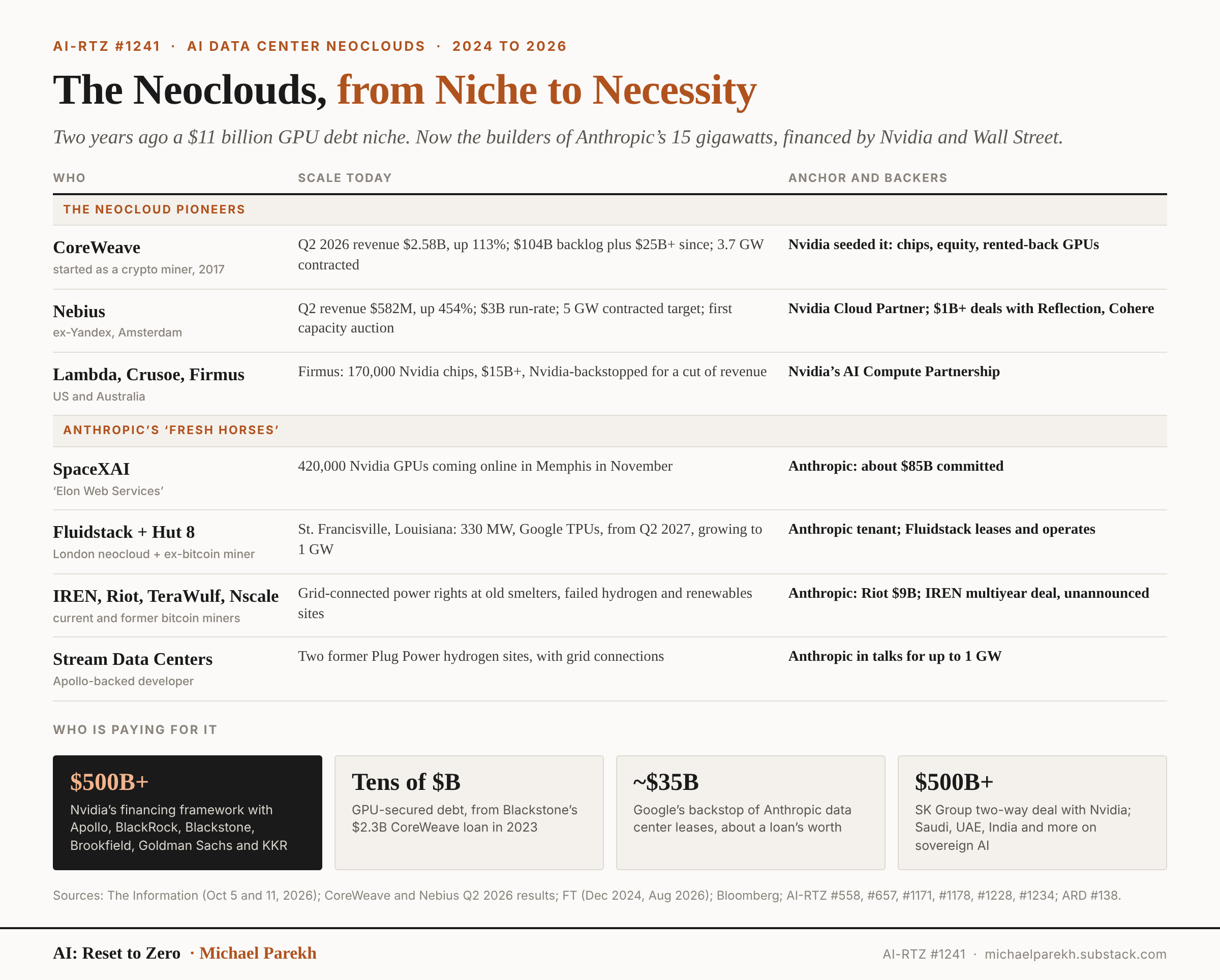
The test from here, as I put it in August, is whether the backstops convert into revenues that stick. Nvidia has put $170 billion behind the answer being yes. The neocloud stocks and bonds will keep marking that bet to market daily.
And Nvidia’s own earnings next month will show how much more it is willing to put on the line as the AI Tech Wave rolls on. Stay tuned.
Sources
Nvidia Has Put More Than $170 Billion on the Line for Neoclouds, The Information, October 20, 2026
How CoreWeave’s Debt Binge Brought a Moment of Reckoning, The Information, October 20, 2026
Nvidia Moves to Back GPU Cloud Provider Firmus After Investors Balk at Its IPO, The Information, October 20, 2026
For longtime readers
AI-RTZ #1246: Anthropic’s $750 Billion Compute Bill, SpaceX’s AI Profit
AI-RTZ #1171: Nvidia the ‘Kingmaker’, Now ‘Uber AI Investor & Banker’
AI-RTZ #1136: Nvidia expands Revenue Share Deals with Customers
RTZ #1036: Nvidia accelerating role as the AI Computing ‘Kingmaker’
AI: Booms that Rhyme (October 2023)
AI: Building Value over Time (the anchor page)
(NOTE: The discussions here are for information purposes only, and not meant as investment advice at any time. Thanks for joining us here.)
Nvidia's backstops make the market trade every neocloud like one credit.
They aren't. $CRWV bonds yield ~15%, others fund on near-zero converts. Funding cost decides who survives the consolidation.