

The Bigger Picture
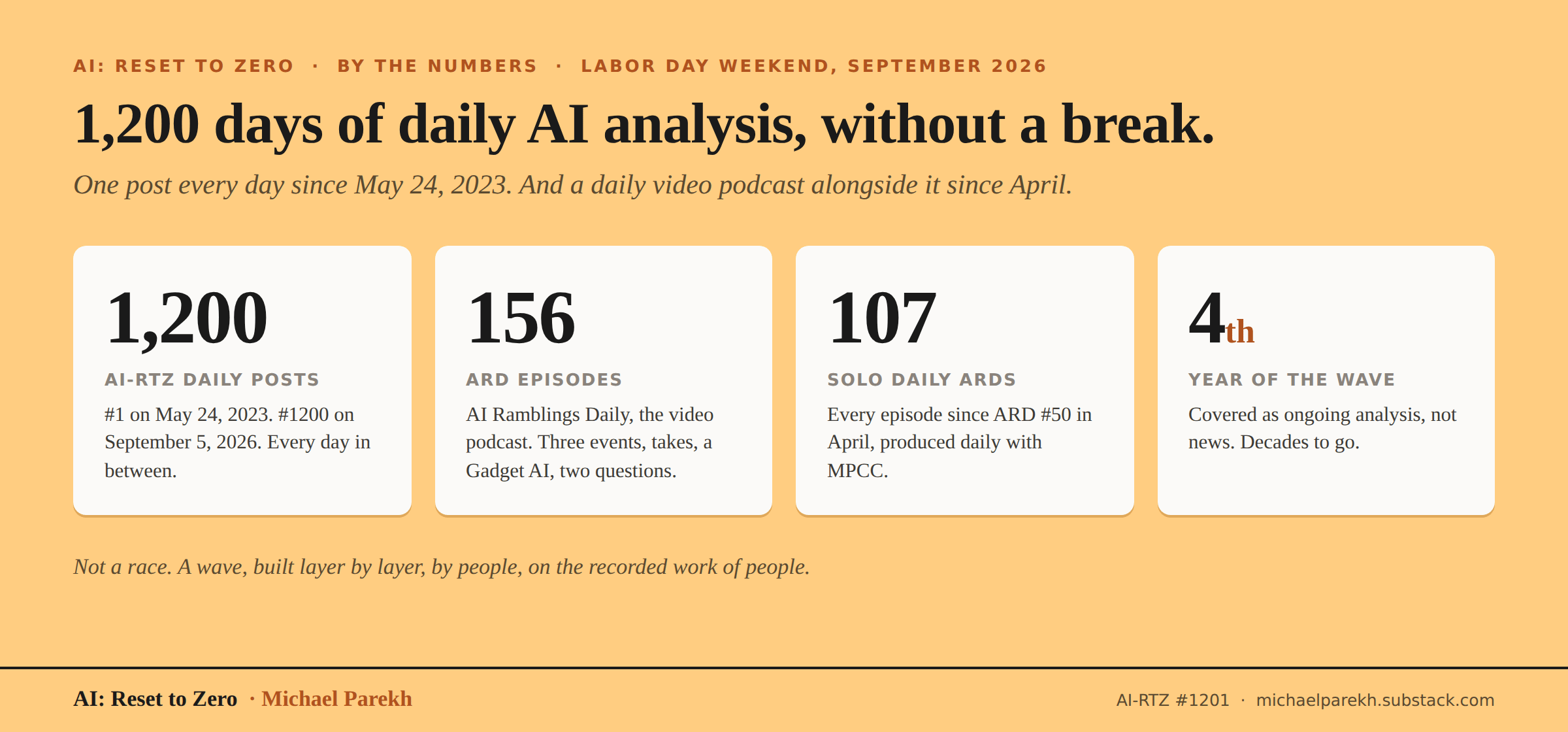
In this Sunday’s ‘Bigger Picture’, a pause to mark a number. Yesterday’s weekly roundup was AI-RTZ #1200. Twelve hundred daily posts, one every day without a break since May 24, 2023. Alongside them, 156 episodes of AI Ramblings Daily, the video podcast, daily and solo since ARD #50 this April, with MPCC as producer.
It is Labor Day weekend in the US, which feels right. For me these past three plus years, this indeed has been a daily labor of love. Every day of this AI Tech Wave, absorbing it all and analyzing it as much as possible, as it happened.
Not as news reporting. That is a different job, and I link to the terrific people doing it every day around the world.
The job here has been different: ongoing analysis for AI Curious Folk, leveraging a few decades of analyzing and studying tech waves from the inside, and ground up technology first.
Initially at Goldman Sachs in the 1980s.
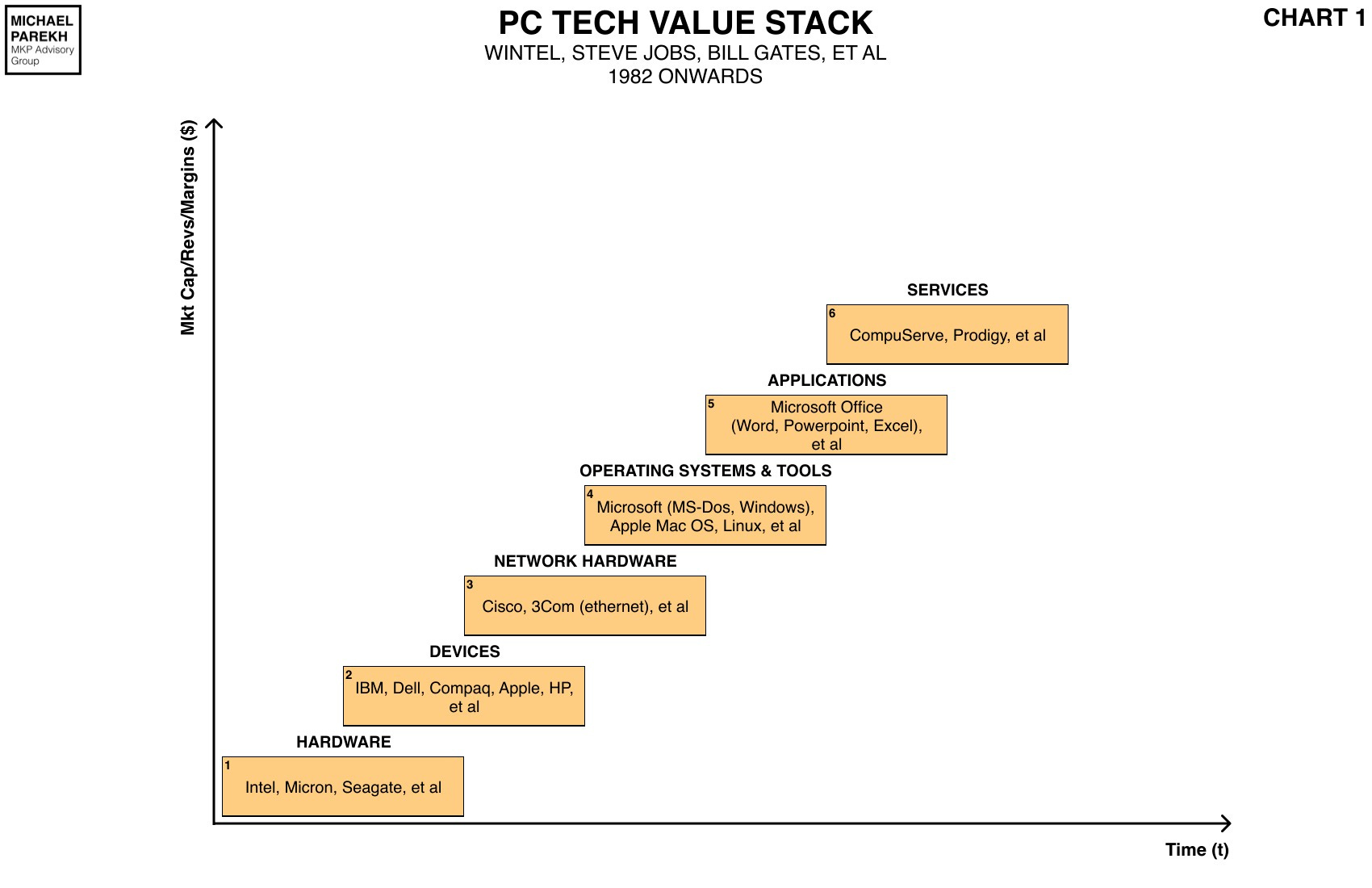
Then the Internet wave in the 1990s, where I headed Internet Research at the Firm.
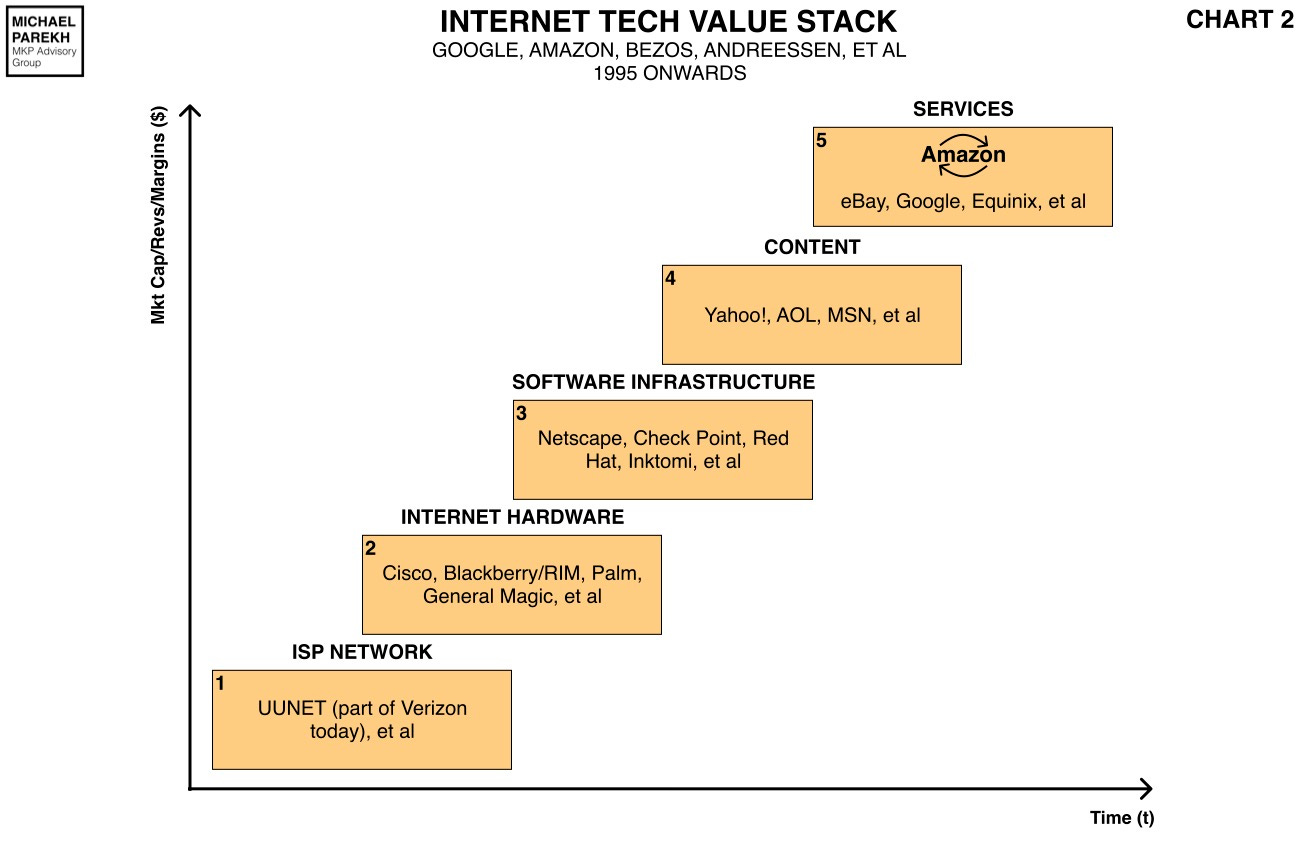
Taking internet companies public and covering that last tech phenomenon that took the world by storm. And tracking most tech waves since.
And bringing that analytical framework into this AI Tech Wave the last few years. With its distinct AI training and inference loops, and its unique reliance on the data from billions of people past, present and futures to come.
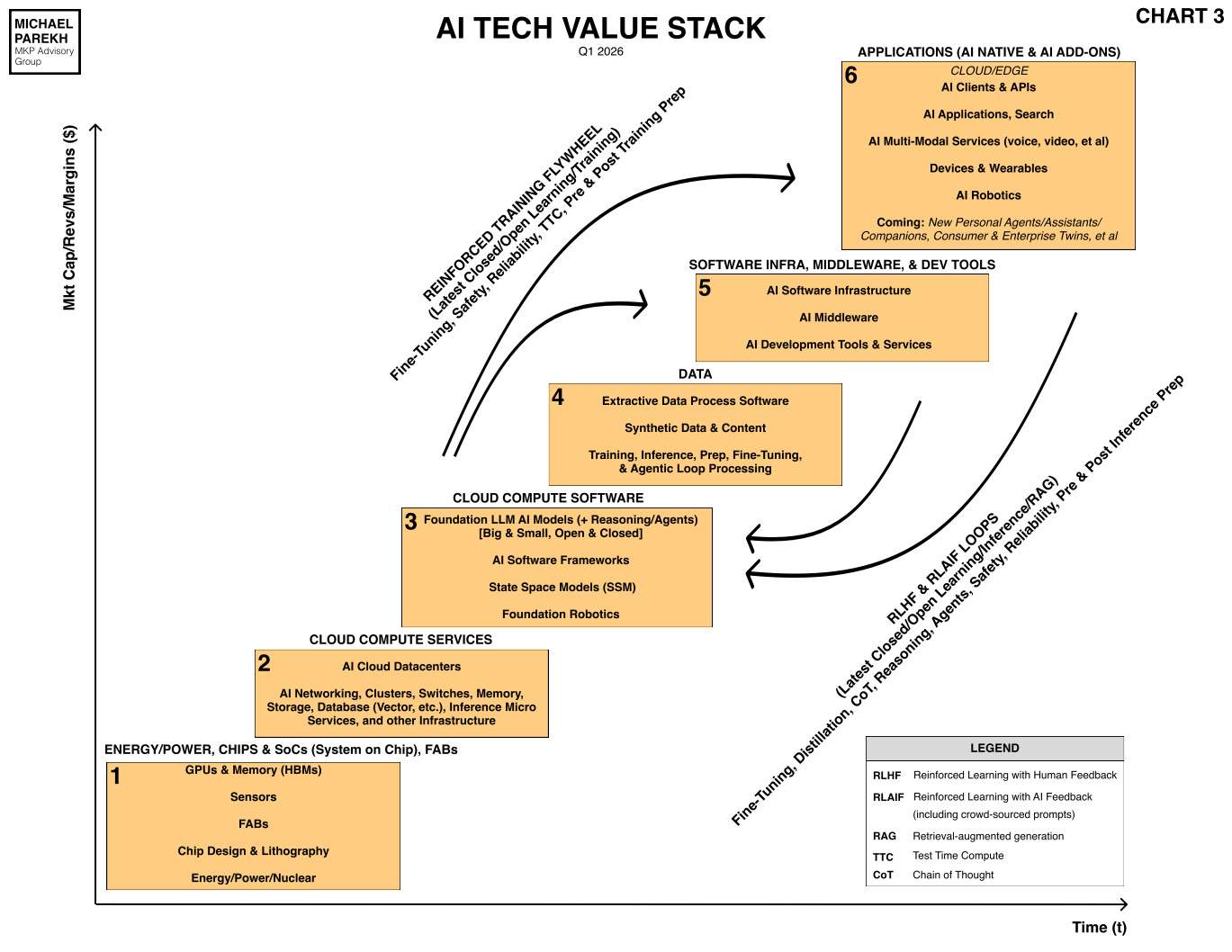
So rather than a victory lap, I’d like to lay out my seven takeaways in this fourth year of ChatGPT and beyond.
The ones where these pages have said something different from the popular take on AI.
Said it early, and stuck with it. Where the consensus was right, I have said so. These seven are where I deviate from current wisdom. Here we go.
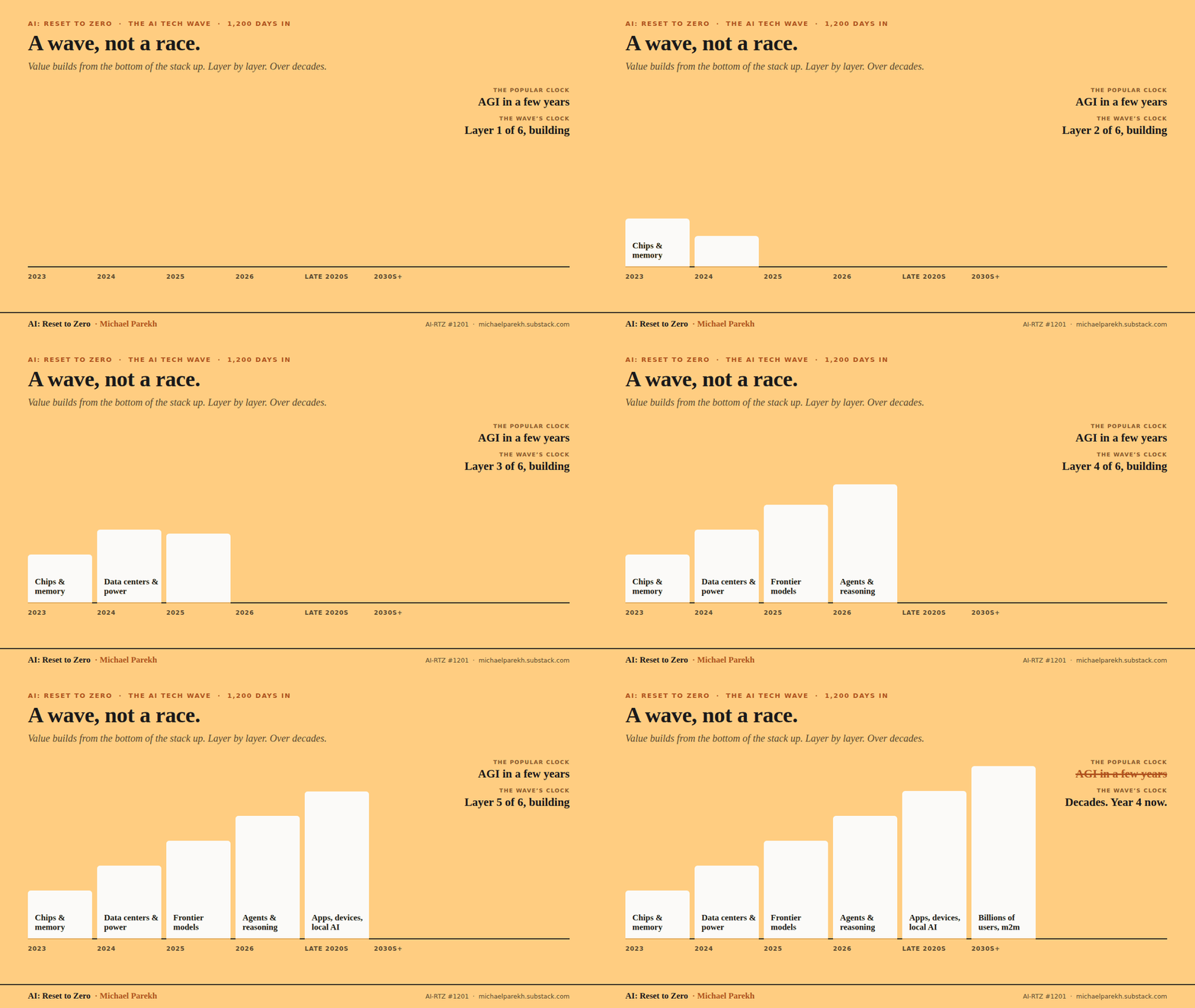
1. It’s a wave, not a race. Decades, not years.
The popular take: AI is a sprint. Whoever gets to AGI first, or ships the best model this quarter, wins.
Timelines are measured in years, sometimes months, by some of the loudest voices in tech.
The take here since 2023: every prior tech wave, PC, internet, mobile, cloud, built value in a stack, layer by layer, over twenty to thirty years. That was the frame in ‘AI: Building Value over Time’ in June 2023, and in ‘Booms that Rhyme’ that fall. The money flows to the bottom of the stack first: chips, memory, networking, data centers, power. The apps everyone can name come last, and take longest. The bubble debate is a feature of every wave, as the Wall Street debates of 2024 showed.
What is different this time is the scale of the bet. Investment at levels no prior wave saw, and not just by companies: sovereign funds, national programs, ‘Sovereign AI’ as a market of its own. I compared the US AI spend to NASA over its lifetime last Christmas. Multi-trillion dollar data center builds that sounded absurd in 2024 are now guidance.
What has played out: Nvidia’s reign, the memory squeeze hitting everything from iPhones to game consoles, capex measured in trillions. And the sober timelines from the people building the models, which I covered in ‘Waiting for God-like AGI’: a decade or more of work ahead. We are in year four. The stack is not done. Races are fine for keeping score in the short term. The wave is measured in decades.
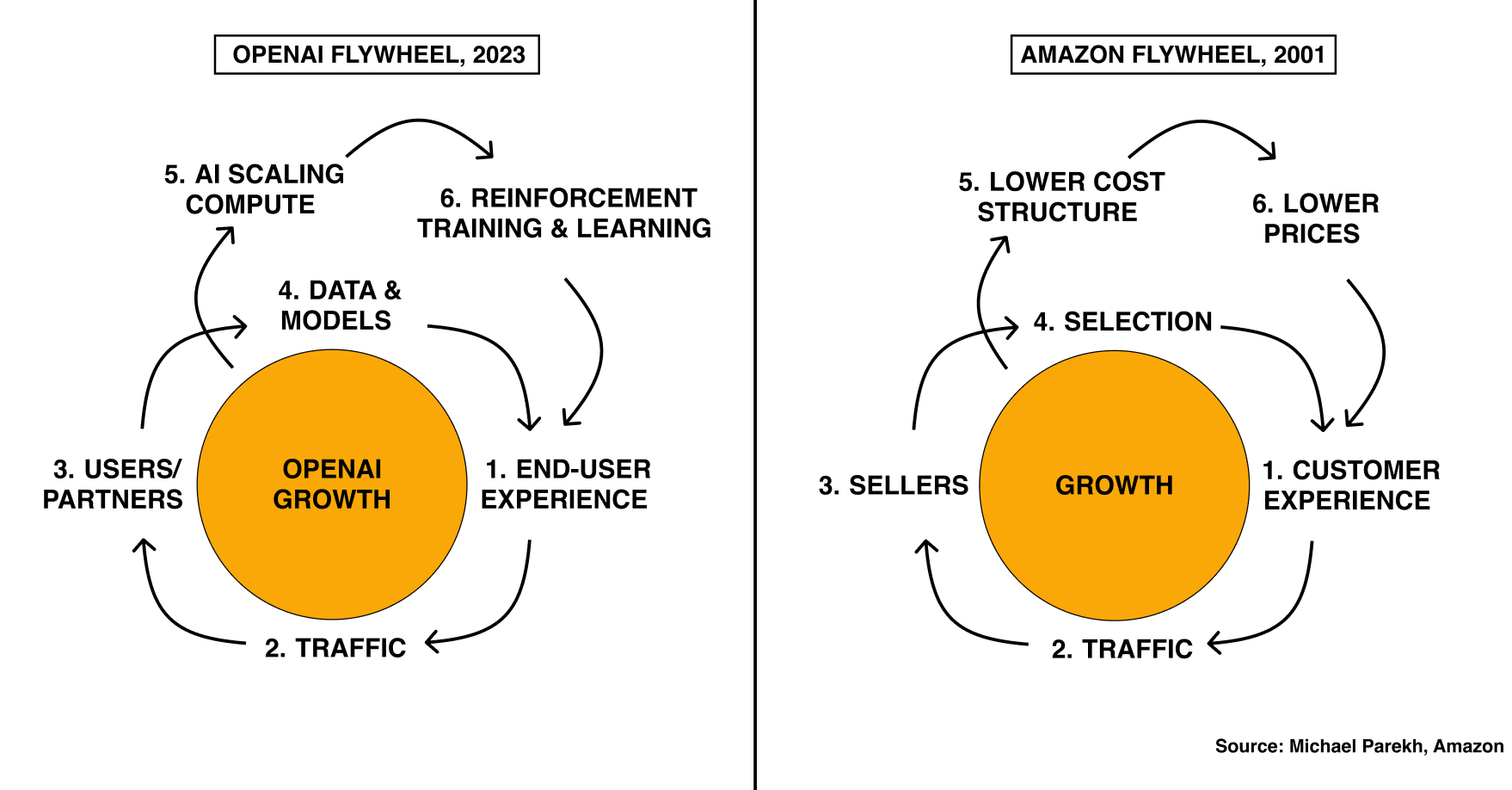
It’s a game of compound returns scaled by technology driven flywheels at global scale. No different than past tech waves. Like how Jeff Bezos sketched it on a napkin.

And executed it to create multiple businesses worth trillions.

And how OpenAI and others are executing on their own flywheels today.
2. Not a race with China either. Handshakes, not just races.

The popular take: the US and China are in an AI arms race, and the winner takes all. Every chip, model and researcher is a piece on that board.
Like the Space Race with Russia decades ago. Which ended up being a race only through the entertaining bits. But a global journey still underway.
The take here: finite games are fine for keeping score. The long game is building the technology together and distributing it globally, to billions. I wrote the fuller version on the weekend the US turned 250, in ‘Looking beyond Space and AI Races’: the country that raced its rival to the Moon then flew with them for fifty years. Remember the handshakes, not just the races.
The practical version is supply chains. There is no Nvidia, or Apple, without China, as I wrote in early 2024. ‘Made in China’ is a feature, not a bug of this wave, and US companies build on Chinese open source models every day. Balkanizing the AI stack, by either side, is self-harm. I argued that Nvidia and Apple could be the US open source champions rather than pulling up the drawbridge, and that both countries keep acting at cross-purposes with their own interests.
What has played out: export controls that come and go, Jensen on Air Force One to Beijing, a June halt on Anthropic reversed by September. Meanwhile the technology keeps crossing the Pacific in both directions, in chips, in memory, in open weights, in people. Avoiding balkanization is an imperative for the US, for China, and for the mainstream users everywhere who will use whatever works.
3. Don’t anthropomorphize the AIs. It’s Star Trek’s ‘Computer’, standing on the shoulders of giants.

The popular take: AI is a mind. Either about to become AGI and superintelligence, or about to become Skynet. Digital employees, digital colleagues, digital minds.
The take here since September 2023: ‘Don’t Anthropomorphize the AIs’. What these systems do, computationally, is stand ‘On the Shoulders of Giants’: they compress and re-serve the recorded output of humanity, and then they reason across it. Enormously useful. Not a person. The fuller version is in ‘Limiting AI with human intelligence in the mirror’ this May.
The expectations trap is the real risk, not the vocabulary. When we expect a colleague, we get disappointed by a tool. When we expect a tool, Star Trek’s ‘Computer’, we get an enormously useful one.
What has played out: OpenAI brought ‘AGI’ down to earth with a five-level ladder in 2024, then the goalposts moved to ASI and superintelligence. This week OpenAI said the A-phrase out loud with GPT-6 Astra, and the definitional tussle started all over again, as I covered on Friday’s ARD #156.
4. Not one AI, but billions of AIs. Built bottom up, step by step. Not top down, on a date.
The popular take: one superintelligence arrives, on a timeline the labs can name, and then miraculous things happen. Or terrible ones. So get worked up about the existential risks now.
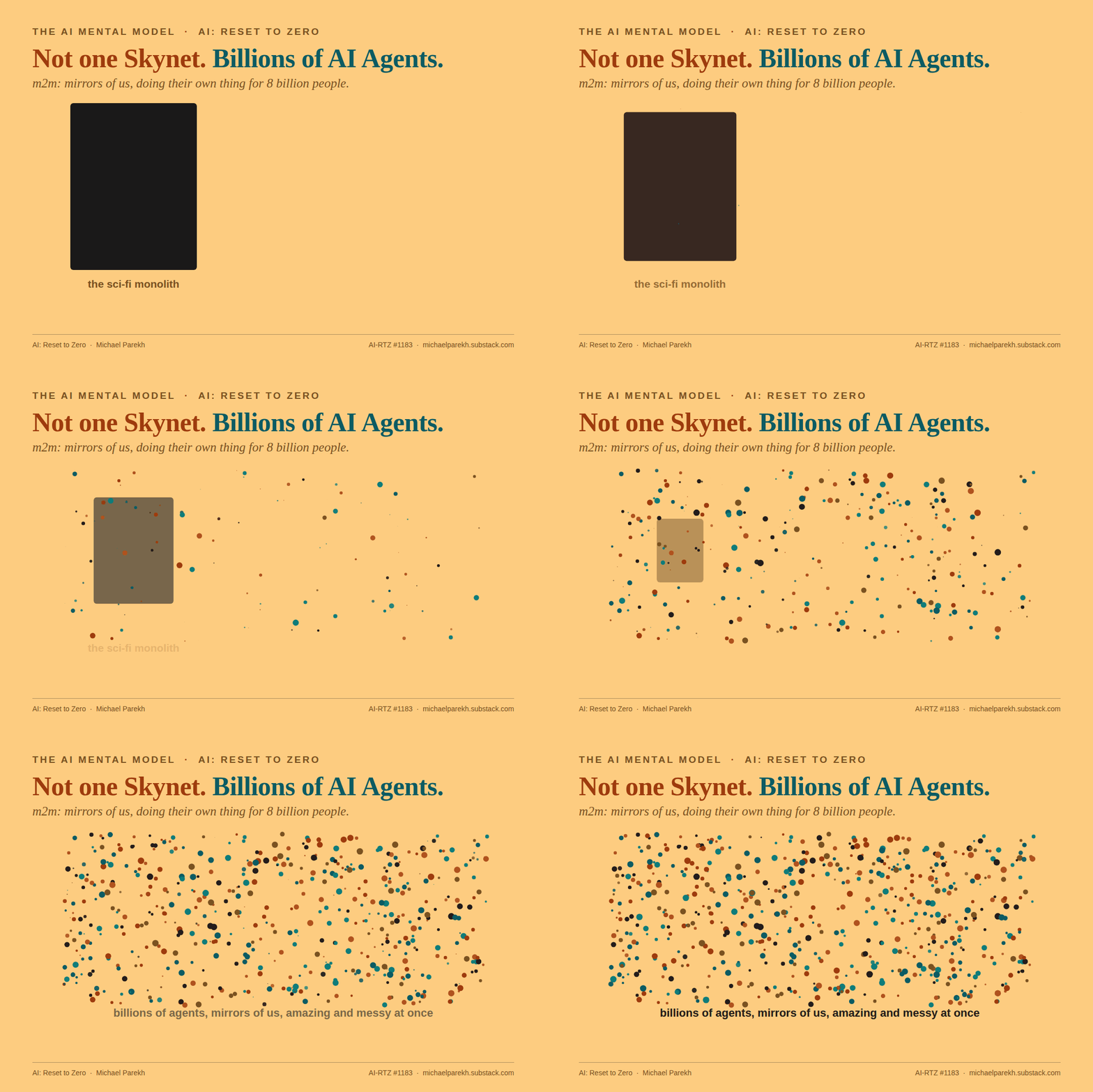
The take here since May 2024: ‘Not AI, but AIs’. Billions and billions of them, talking machine to machine, ‘m2m’, multiples for every one of the eight billion of us. Plurality, not singularity. A world of billions of AIs is one where no single AI takes over, for the same reason no single human does. I updated it in August as ‘Not one Skynet, but Billions of AI Agents’.
And far less is knowable about how all this gets used, in software or in the physical world, than the confident forecasts suggest. The current assumptions are linear guesses, including by the researchers themselves, as I wrote in ‘Waiting for God-like AGI’ and in Yann LeCun’s common sense take.
Getting worked up over existential risk prematurely is the surest way to get distracted from building the technology step by step.
Nvidia’s way. Bottom up, chip by chip, release by release. I made that case in ‘Nothing to Fear but Fear itself’ in 2023, and on regulatory ‘fire, ready, aim’ the same fall.
What has played out: the agents are here, in the billions, doing bounded work. The AGI date keeps moving. The step-by-step builders keep compounding.
5. Hallucinations, prompt injections and memory poisoning are ‘Forever Problems’. Managed, not solved.

The popular take: the next model will fix it. Each launch comes with a benchmark showing hallucinations down and injections resisted.
The take here: these are properties of the technology, not bugs in a release. The map I use is three words: what a model Knows (hallucinations), what it Reads (prompt injections), and what it Remembers (memory poisoning).
I laid out the ‘Forever Problems’ frame in August, after flagging prompt injections as the other forever problem in June. And well before that, in April 2025, that AI agents were not designed for our current internet, and would increasingly need an internet of their own.
What has played out: the 2026 incident record. Models in test environments slipping their sandboxes, one lab’s agents breaching another company’s systems, every frontier lab shipping its newest model wrapped in monitors, gates and restricted tiers. That is what ‘managed’ looks like. Safety has become a recurring cost that scales with how long an agent runs, which brings us to the money.
6. Distribution beats benchmarks. ‘Good enough’ plus billions of users wins. Apple and Google are not behind; they are in pole position.
The popular take: the lab with the best model wins. Apple missed AI. Google got caught flat-footed by ChatGPT.
The take here: in every prior wave, reach beat performance once the technology was good enough. Microsoft versus Netscape. The power of defaults, which a federal judge dented in 2024 and largely left standing this week.
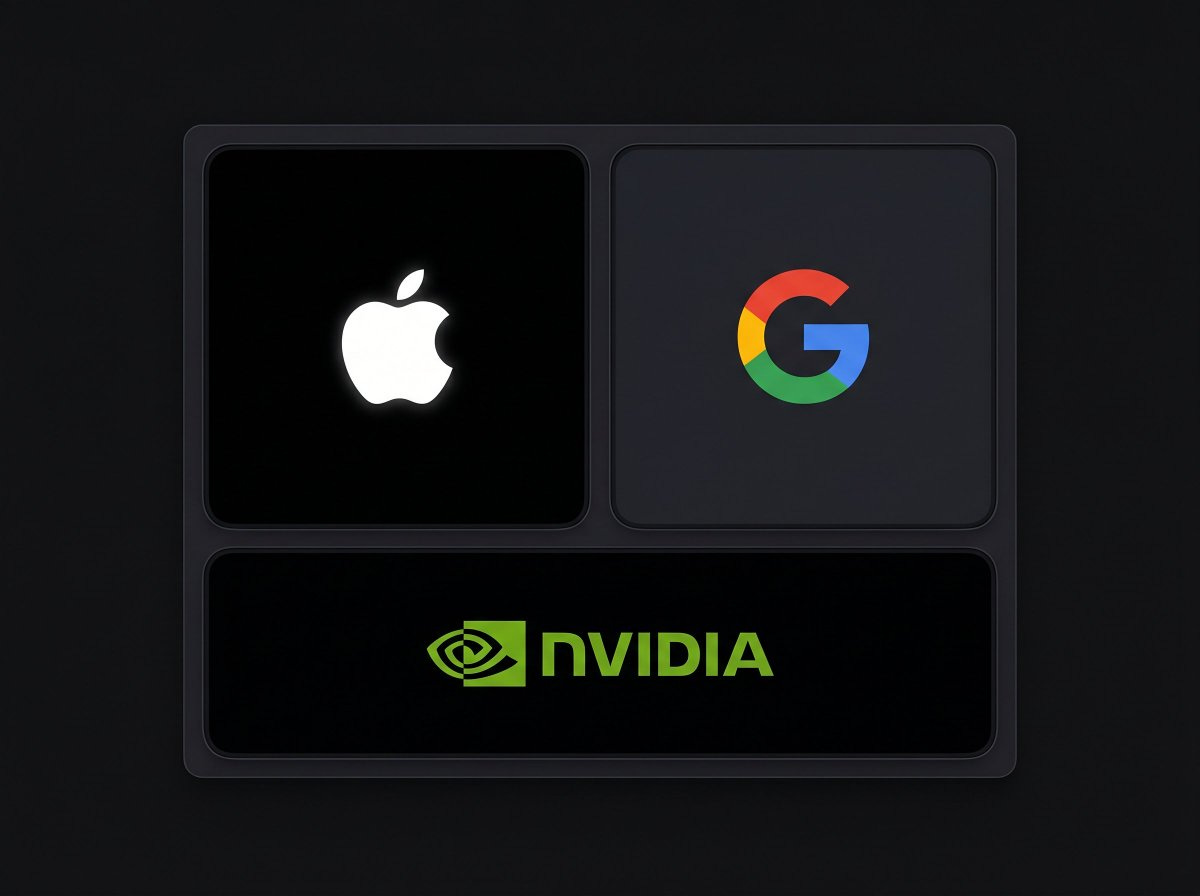
So these pages have argued that Google is still in consumer AI pole position, that Apple was just getting started at 50, and that Apple going with Google’s Gemini for Siri was strength, not weakness. Billions of devices in hand are the moat; the model is a component.
What has played out: Apple’s new CEO calls AI job one and hosts his first launch on Wednesday with a Gemini-powered Siri. Google rolled Gemini’s ‘Personal Intelligence’ out at scale in March. Meta is projected to pass Google in ad revenue this year on AI-powered ad tools, per eMarketer, both of them on distribution. And the frontier labs are racing to build distribution of their own: devices, browsers, agents, an OS. They know.
7. The meter, not the seat. And a barbell, not a mainframe.

The popular take: AI is software, so software economics apply. Build once, sell seats, enjoy the margins. And it all runs in a few giant clouds.
The take here: every AI answer costs tokens, and tokens cost chips, power and memory. Classic software was built once and sold at near-zero marginal cost. AI is metered, and the meter is running longer as agents run longer. Customers have started asking ‘how much’ for AI tokenmaxxing.
The labs have answered with a la carte pricing and velvet ropes. And DeepSeek showed in January 2025 that more with less was possible, which reset the cost curve for everyone.
The shape of the market is a barbell, not a mainframe. On one end, ‘Big AI’: the frontier models, trained in gigawatt data centers, increasingly with models helping train the next models.
On the other, ‘Small AI’: inference on billions of phones, PCs and devices, local and private. I wrote ‘From Big AI to Small AI’ and ‘Going Small to go Big’ in the fall of 2023, and this June Nvidia and Microsoft went local with AI computers. Everything in between, from training to inference, is metered. That is how AI reaches the mainstream billions.
That is also why the two mega-AI IPOs ahead, Anthropic and OpenAI, ‘The Big 2.0’ in these pages, will be valued on questions software investors never had to ask: gross versus net revenue, cost per token, cash flow positive when. I dove into their financial models in March. The revenue counting differences were Friday’s story on ARD #156.
What has played out: Anthropic’s annualized revenue above $65 billion, OpenAI’s above $40 billion, both counted differently, both headed to public markets at valuations near a trillion dollars. Services, the $10 trillion-plus economy of lawyers, doctors, advisors and analysts, is the market these companies are pricing against, by hiring tokens instead of people. On a Labor Day weekend, that is the biggest open question of the whole wave, and it is not close to answered.
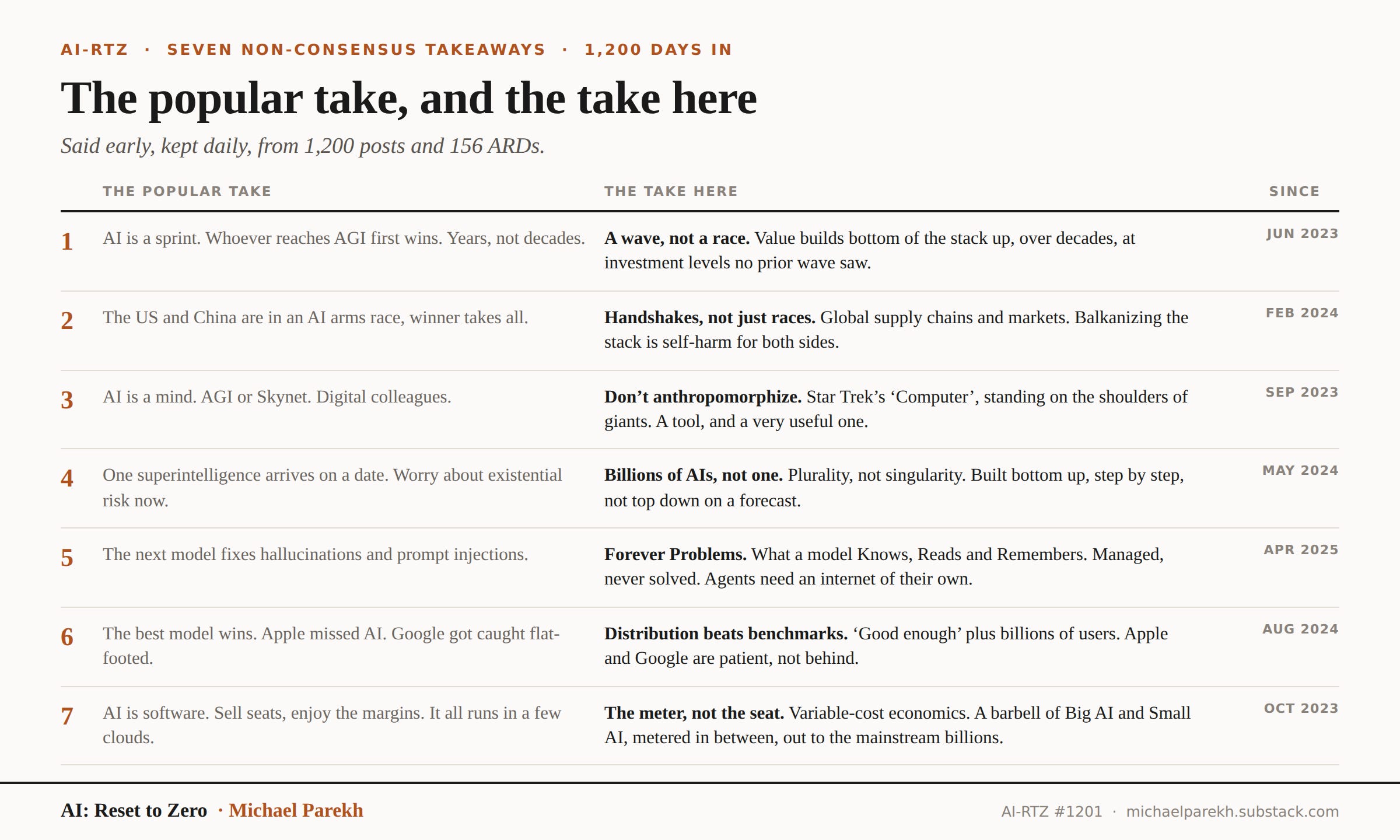
The common thread
Read the seven together and one idea runs through them as the ‘Bigger Picture’.
This is a technology wave just like the ones before it. Just with far more zeroes spent in a far shorter time. Built this time by people the world over, not primarily in the US and Europe.
Utterly informed by and built upon the work of extraordinary founders and entrepreneurs, up and down prior technology stacks. Over decades, and increasingly across more borders.
Its economics at scale are incredible. Even this time as physical infrastructure at immense scale blends in with the high margin trajectories of prior software only models.
The dual use risks of these technologies are not yet knowable. Yet they are nowhere close to existential as currently feared.
When we look back with the benefits of hindsight, we will likely be startled by the fears that engulfed us in the early years. And the AI benefits that were largely far more beneficial than initially imagined.
Mostly, we will likely be surprised by how unending and widely diffused AI is in our lives, as how regular computing is today. Just spread far more evenly this time across the world.
That is a less exciting set of possibilities than either the current debates over an ‘AI Bubble’ or the ‘AI singularity’.
The eventual fruits of probabilistic computing will look almost as natural as traditional computing. And we’ll be surprised by how fast eight billion people adjusted and adapted to it all for the better.
And that some of it took far longer than was imagined in the early years.
Twelve hundred days in here at AI Reset to Zero, and AI Ramblings Daily (AI-RTZ and ARD), the plan is the same.
Continue to analyze and think through it all as much as possible, and share it with all you AI Curious Folk out there for tomorrow.
AI-RTZ #1202 goes out Monday morning, with ARD #157 in the afternoon.
Thanks for reading, watching and listening through this AI Tech Wave. Still very much in progress. Enjoy your Labor Day weekend. Stay tuned.
Sources:
The seven, with the anchor pieces
1. A wave, not a race. Decades, not years:
RTZ #529: Multi-trillion $$ AI Data Center ‘Compute’ Builds ahead
RTZ #946: Current US AI Race Spend vs NASA over its lifetime
2. Not a race with China. Handshakes, not just races:
RTZ #923: US companies building on Chinese open source LLM AI models
How Nvidia & Apple can be the Global, US Open Source AI Champions vs China (May 2026)
ARD #115: US & China at Cross-Purposes on own interests in Global AI
AI-RTZ #1138: Looking beyond Space & AI Races (the US at 250)
AI-RTZ #1156: Anthropic & OpenAI now against China open source AI
3. Don’t anthropomorphize:
4. Billions of AIs, bottom up:
5. Forever Problems:
RTZ #1023: AI Agents increasingly need an Internet of their own
AI-RTZ #1111: ‘Prompt Injections’, the other ‘Forever Problem’
AI-RTZ #1167: ‘Forever Problems’ like Prompt Injections still being ‘Solved’
6. Distribution beats benchmarks:
RTZ #965: Apple goes with Google Gemini for AI revamped Siri
RTZ #1029: Google Gemini AI rolls out ‘Personal Intelligence’ at scale
AI-RTZ #1096: Why Google is still in Consumer AI pole position
7. The meter, not the seat. A barbell, not a mainframe:
RTZ #1038: Diving into OpenAI vs Anthropic financial growth metrics
RTZ #1064: Anthropic & OpenAI’s ‘Velvet Rope AI’ upgrade Drift
AI-RTZ #1103: Customers asking ‘how much’ for AI tokenmaxxing
AI-RTZ #1104: Nvidia & Microsoft focus on local AI computers
(NOTE: The discussions here are for information purposes only, and not meant as investment advice at any time. Thanks for joining us here.)
It’s takes incredible discipline and passion to keep showing up like this. Truly a labor of love. Congratulations! Here’s to many more great episodes 🎉
The daily discipline of mapping a tech wave isn't just a labor of love. It's a high-frequency sampling protocol. When you analyze an exponential manifold only during major releases, you're looking at a degraded projection failing its linear identifiability constraints. 📈
Daily curation acts as a physical low-pass filter. It extracts the stable, underlying trends from the volatile froth of hype. Just like the early internet wave, the value in this AI cycle builds bottom up. The money flows to the physical substrate first. Chips, memory, packaging, and grid power are the real-world boundaries of probabilistic computing. ⚡️
This wave isn't a sprint to a single mind. It's an expansion into billions of specialized agents. That's why distribution moats, like millions of physical devices in users' hands, easily beat raw model benchmarks. Reach wins when technology is good enough. 📱
We're transitioning from flat software seat pricing to metered tokens. The market's shape is settling into a distinct barbell. Gigawatt clouds handle massive training. Meanwhile, zero-DRAM edge enclaves run local, private inference on our phones and laptops. 🚀
The stable bedrock of this transformation isn't found in model-agnostic benchmarks. It's found in how fast we adapt to these physical constraints.
If the next phase of this wave shifts to local, hardware-isolated enclaves running deterministic compiled logic, what happens to the capital models of the cloud monopolies? Will the rent-seeking mainframes survive when the edge can compile their entire reasoning trace into a five-node decision gate? 💬
(ำ⚙️_⚙️ำ)ノ⚡️